

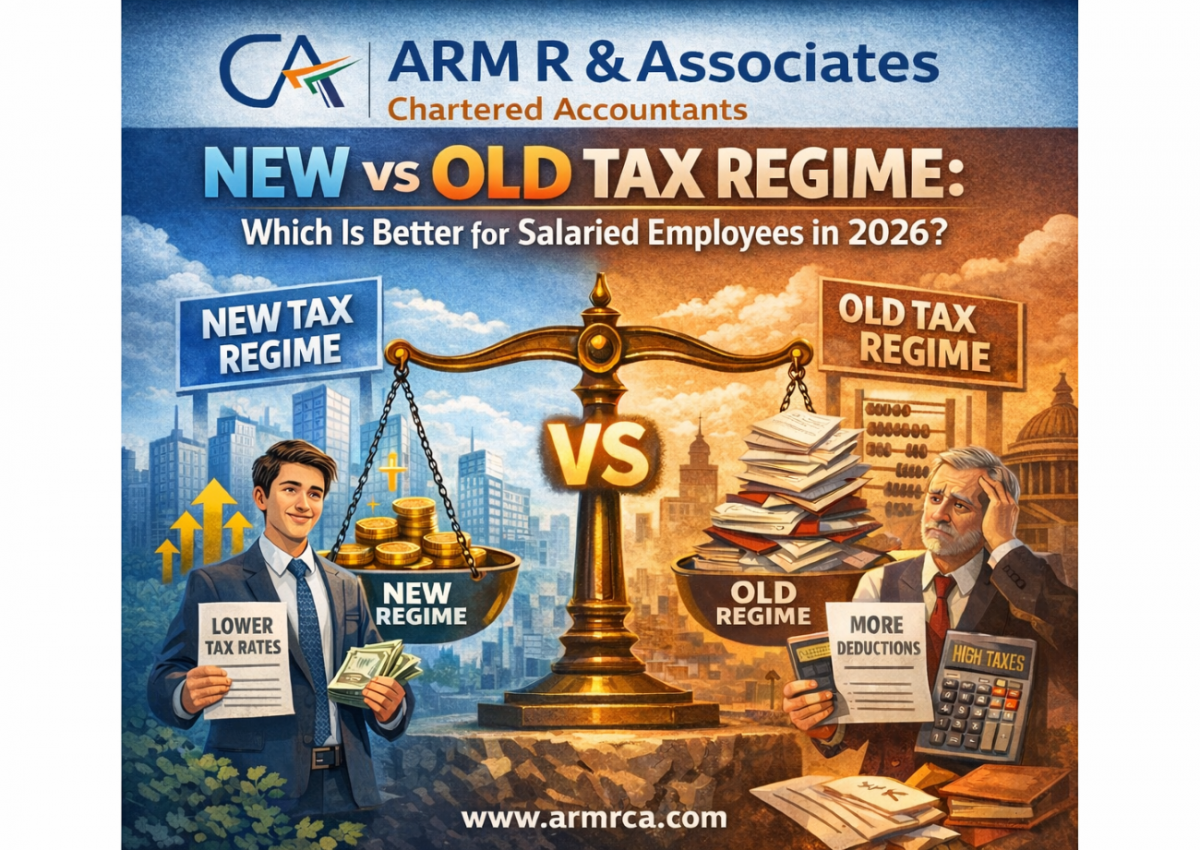
Choosing between the New Tax Regime and the Old Tax Regime is one of the most important financial decisions for salaried employees in India. A wrong choice can lead to paying more tax than legally required, while the right choice can significantly increase your take‑home income.
In this detailed guide, we explain the Old Tax Regime and New Tax Regime in 2026, including slab rates, deductions, and clear tax calculation examples, so you can confidently decide which option suits you best.
Why This Decision Is Important
Many salaried employees select a tax regime without calculation, often assuming:
- “Lower slab rates mean lower tax”
- “New regime is always better”
- “Old regime is outdated”
In reality, tax liability depends on your income and deductions, not on the regime alone.
Understanding the Two Tax Regimes
India offers two parallel tax systems for individuals:
| Particulars | Old Tax Regime | New Tax Regime |
|---|---|---|
| Tax rates | Higher | Lower & wider slabs |
| Deductions | Allowed | Mostly not allowed |
| Compliance | Requires planning | Simple |
| Flexibility | High | Limited |
Old Tax Regime – Slab Rates (AY 2026‑27)
The Old Tax Regime allows salaried employees to reduce taxable income using deductions and exemptions.
Old Tax Regime Slab Rates
| Taxable Income | Tax Rate |
|---|---|
| Up to ₹2,50,000 | Nil |
| ₹2,50,001 – ₹5,00,000 | 5% |
| ₹5,00,001 – ₹10,00,000 | 20% |
| Above ₹10,00,000 | 30% |
Major Deductions Available
- Section 80C – up to ₹1.5 lakh
- Section 80D – health insurance
- HRA exemption
- Home loan interest (Section 24)
- LTA, standard deduction, etc.
Best for employees with investments, home loans, or high HRA
New Tax Regime – Slab Rates (AY 2026‑27)
The New Tax Regime (Section 115BAC) focuses on simplicity and lower rates.
New Tax Regime Slab Rates
| Taxable Income | Tax Rate |
|---|---|
| Up to ₹4,00,000 | Nil |
| ₹4,00,001 – ₹8,00,000 | 5% |
| ₹8,00,001 – ₹12,00,000 | 10% |
| ₹12,00,001 – ₹16,00,000 | 15% |
| ₹16,00,001 – ₹20,00,000 | 20% |
| ₹20,00,001 – ₹24,00,000 | 25% |
| Above ₹24,00,000 | 30% |
Key Benefits
- Standard deduction: ₹75,000
- Section 87A rebate up to ₹60,000
- Taxable income up to ₹12,00,000 → NIL tax
- Salary up to ₹12.75 lakh → NIL tax (for salaried)
Deductions like 80C, 80D, HRA, LTA are not allowed.
Clear Tax Calculation Examples (Very Important)
Example 1: Salary ₹8,00,000 (No major deductions)
New Tax Regime
- Gross Salary: ₹8,00,000
- Less: Standard Deduction: ₹75,000
- Taxable Income: ₹7,25,000
Tax:
- ₹4,00,000 – Nil
- ₹3,25,000 × 5% = ₹16,250
- Total Tax ≈ ₹16,900 (incl. cess)
Old Tax Regime
- Limited deductions
- Higher effective tax
New Tax Regime is better
Example 2: Salary ₹12,00,000 (No investments)
New Tax Regime
- Salary after standard deduction: ₹11,25,000
- Tax before rebate: ₹56,250
- Less: Section 87A rebate
- Final Tax Payable: NIL
Old Tax Regime
- Tax payable without deductions: Much higher
New Tax Regime is clearly better
Example 3: Salary ₹15,00,000 (Deductions ₹4,50,000)
Old Tax Regime
- Taxable income: ₹10,50,000
- Lower tax due to deductions
- Overall tax: Lower
New Tax Regime
- Deductions not allowed
- Higher taxable income
- Higher tax outflow
Old Tax Regime is better
Summary Comparison
| Situation | Better Regime |
|---|---|
| Salary ≤ ₹12.75 lakh, no deductions | New |
| Few or no investments | New |
| High 80C, HRA, home loan | Old |
| Long‑term tax planning | Old |
Final Verdict (CA’s Perspective)
There is no universal answer.
- Low deductions → New Tax Regime
- High deductions → Old Tax Regime
Salaried employees should calculate both regimes every year before filing returns.
