

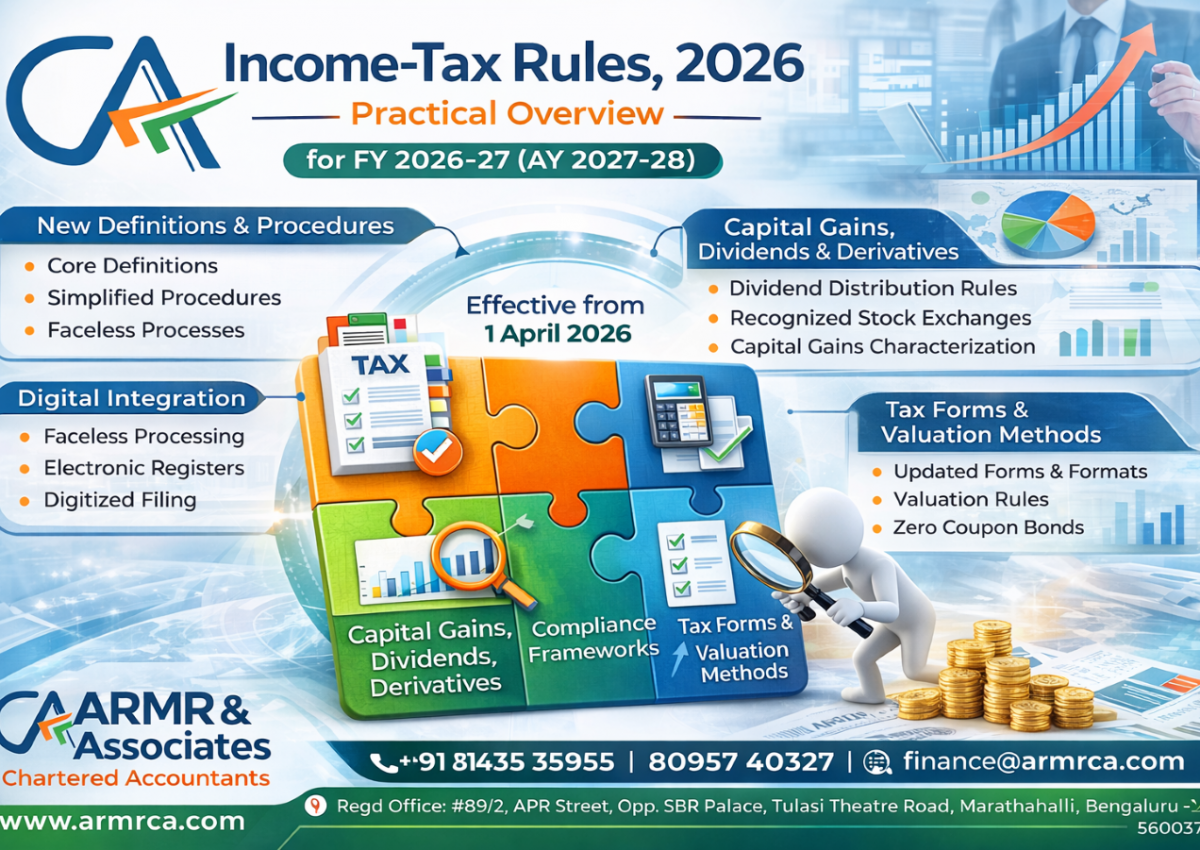
The Ministry of Finance has notified the Income-tax Rules, 2026 in exercise of its powers under section 533 of the Income-tax Act, 2025, with effect from 1 April 2026. These Rules operationalise the new Act by prescribing procedures, forms, definitions, valuation methods and compliance frameworks for taxpayers, intermediaries and professionals.
1. Background and Scope of the Income-tax Rules, 2026
The Income-tax Rules, 2026 (“the Rules”) are subordinate legislation framed by the CBDT under section 533 of the Income-tax Act, 2025. They apply to all taxpayers covered by the 2025 Act and replace the earlier Income-tax Rules, 1962, with effect from 1 April 2026 (tax year 2026-27).
Key features of the new Rules are:
- Alignment with the structure, section numbering and terminology of the Income-tax Act, 2025
- Consolidation and rationalisation of procedures, forms and definitions
- Integration with digital systems (authorised banks, Forms in Appendix III, electronic registers, faceless processes)
Rule 2 provides core definitions: “Act” means the Income-tax Act, 2025, “authorised bank” refers to an RBI-appointed agent under section 45 of the RBI Act, 1934, and “Form” means a form in Appendix III to the Rules.
2. Dividends, Stock Exchanges and Capital Gains – Key Substantive Rules
2.1 Declaration and Payment of Dividends in India – Rule 3
Rule 3 prescribes the arrangements required for declaration and payment of dividends within India for companies referred to in section 242 of the Act. Broadly, the company must:
- Maintain its share register for all shareholders at its principal place of business in India from at least 1 April of the relevant tax year
- Hold the general meeting for passing accounts and declaring dividends only in India
- Ensure dividends, if declared, are payable only in India to all shareholders.
This has practical implications for cross-border structures and for determining whether certain dividend concessions and treaty positions are available.
2.2 Recognised Stock Exchange for Derivatives – Rules 4 and 5
For the purposes of section 292 of the Act, a stock exchange must satisfy specific conditions to be notified as a “recognised stock exchange” for trading in derivatives.
Rule 4 requires, among others:
- SEBI approval for derivatives trading and compliance with SEBI guidelines
- Recording and storage of unique client ID and PAN in exchange databases
- Maintenance of a complete audit trail of all cash and derivative transactions for seven tax years
- Prohibition on erasing registered trades, and controlled modification only for genuine errors
- Monthly reporting in Form No. 1 to DGIT (Systems) of all modified transactions.
Rule 5 lays down the procedure for notification of a recognised stock exchange:
- Application to Member (Income Tax), CBDT, New Delhi
- Enclosure of SEBI approval, rules, bye-laws, trading regulations and confirmations of compliance with Rule 4(b)–(f)
- Power of the Central Government to seek further information and to notify or reject within six months
- Notification effective until SEBI approval is withdrawn or the notification is rescinded.
This framework is critical for determining tax treatment of derivative transactions, especially in relation to section 292 and related safe harbours.
2.3 Period of Holding and Capital Gains Characterisation – Rule 6
Rule 6 prescribes how to compute “period of holding” for certain capital assets, which directly affects classification as short-term or long-term capital assets under the Act.
Illustrative cases:
- Conversion instruments: For shares or debentures that become property of the assessee under section 70(1)(z), the period of holding includes the period for which the bond, debenture, debenture-stock or deposit certificate was held prior to conversion.
- Assets under the Income Declaration Scheme, 2016: For immovable property with a registered deed, the period is reckoned from the date of acquisition; in any other case, from 1 June 2016.
- Conversion of a branch of a foreign company into an Indian subsidiary under section 219(1): The period of holding includes the period during which the asset was held by the foreign branch or by the previous owner in qualifying modes of acquisition.
Rule 6(3) further clarifies attribution of “specified entity” capital gains under section 67(10) as short-term or long-term depending on the nature of underlying assets (short-term, block of assets, self-generated assets or long-term assets).
2.4 Zero Coupon Bonds – Rule 7
Rule 7 sets out the procedure and conditions for notification of zero coupon bonds under section 211(2) of the Act.
Key aspects:
- Eligible issuers: Infrastructure capital company, infrastructure capital fund, infrastructure debt fund, or specified public sector company
- Application: Form No. 2, at least three months before issue, not for bonds to be issued beyond two financial years after the year of application
- Documentation: Certificate of incorporation or trust deed, relevant statute in case of statutory corporations
- Substantive conditions:
- Bond life: Not less than 10 years and not more than 20 years
- Investment-grade rating from at least two SEBI-registered credit rating agencies
- Listing on a recognised stock exchange in India
- Staggered deployment of realisation (minimum 25% by the end of the next financial year and balance within four subsequent financial years)
- For infrastructure debt funds: Maintenance of a sinking fund and investment of accrued interest in Government securities.
The Central Government must specify the bond by notification, including name, tenure, issue schedule, maturity amount, discount and number of bonds, and has power to withdraw the notification for non-compliance.
2.5 Period of Stay in India for Seafarers – Rule 8
Rule 8 provides a beneficial mechanism for computing the period of stay in India for Indian citizen crew members of foreign bound ships for the purposes of section 6(6) residency tests.
- The period between the date of joining and date of signing off, as entered in the Continuous Discharge Certificate (CDC), is excluded for eligible voyages.
- “Eligible voyage” covers ships carrying passengers or freight in international traffic where the voyage originates in India and ends abroad, or vice versa.
This rule is crucial for determining residential status of seafarers and their global income exposure.
2.6 Income Determination for Non-residents – Rule 9
Where the Assessing Officer cannot definitely ascertain the actual income accruing or arising to a non-resident from assets, properties or business connections in India, Rule 9 allows a “best judgment” basis of approximation.
The AO may compute income:
- As a reasonable percentage of Indian turnover, or
- In proportion to worldwide profits based on the ratio of Indian receipts to total receipts, or
- In such other manner as the AO deems suitable.
For cross-border clients, this rule underlines the importance of robust transfer pricing and documentation to avoid adverse estimations.
3. Valuation and Fair Market Value Rules
3.1 Definitions for Valuation – Rule 10
Rule 10 defines key concepts for Rules 11 and 12 (fair market value in indirect transfer and other valuation contexts).
Important defined terms include:
- “Accountant” – linked to section 515(3)(b), with additional conditions on professional experience and receipts, and recognition of certain foreign valuers.
- “Balance sheet” – definition aligned with Indian or foreign company law, including interim balance sheets and certification requirements.
- “Book value of liabilities” – excludes equity capital, general reserves, surplus and securities premium related to equity capital.
- “Observable price” – based on average of weekly high/low closing prices over defined periods on the relevant stock exchange.
- “Right of management or control” – broadly defined to include control via shareholding, agreements or any other manner.
These definitions ensure consistency in computing FMV for cross-border and indirect transfer transactions.
3.2 Fair Market Value of Assets – Rule 11
Rule 11 lays down detailed methods for determining FMV of assets for section 910 (indirect transfer) purposes, as on the “specified date”.
Illustrative methods:
- Listed shares of an Indian company:
- FMV equals observable price on the recognised stock exchange; where control rights exist, a formula based on market capitalisation minus book value of liabilities divided by total shares is used.
- Unlisted shares of an Indian company:
- FMV determined by a merchant banker or accountant using internationally accepted valuation methods, adjusted by adding back considered liabilities.
- Partnership interests or AOP interests:
- Value of firm/AOP determined by valuer, allocated between capital portion and residual portion based on capital contribution and dissolution-sharing ratios.
- Other assets:
- FMV equals open market price determined by merchant banker or accountant, plus any liabilities already netted off.
The Rule also provides a formulaic method to determine FMV of all assets of a foreign company or entity where transfers are between unconnected persons, linking observed consideration to global asset valuation.
For advisory work, these provisions are central when analysing cross-border M&A, private equity exits, and offshore holding structures.
4. Registered Valuers – Qualification, Registration and Fees
4.1 Registration as Valuer under Section 514 – Rules 246 to 249
Rules 246 to 249, extracted in the notification, create a complete ecosystem for registration, qualification and regulation of valuers under section 514 of the Act.
Key elements include:
- Registration process and transitional treatment for existing valuers under the Wealth-tax Act, 1957
- Mandatory examination within a prescribed time for registered valuers, failing which registration stands cancelled
- Class-wise qualification requirements for valuers across asset classes such as immovable property, agricultural land, plantations, forests, mines, shares and securities, machinery, jewellery, works of art and life interests.
For example, a valuer of immovable property (other than agricultural lands) must typically be:
- A graduate in civil engineering, architecture, town planning or a post-graduate in valuation of real estate
- With specified years of employment or practice experience and minimum gross receipts thresholds in practice.
Similar, detailed criteria exist for valuers of securities/business, plant and machinery, agricultural land, plantations, etc.
Rule 247 also prescribes disqualifications: dismissed government servants, persons convicted of tax offences or penalised under specified sections, undischarged insolvents, those found guilty of professional misconduct, minors, persons of unsound mind or bankrupt individuals.
Rule 248 caps fees chargeable by valuers and mandates valuation reports in Form No. 170 for section 514(3) purposes. Rule 249 empowers tax authorities to remove and periodically review valuers, with inquiry powers similar to a civil court under the Bharatiya Nyaya Sanhita, 2023.
For practitioners, this regime significantly raises the bar on valuation quality and documentation in scrutiny, litigation and transaction planning.
5. Income-tax Practitioners and Authorised Representatives
5.1 Income-tax Practitioners – Rules 250 to 258
Rules 250 to 258 deal with income-tax practitioners (ITPs) and authorised representatives under section 515.
Highlights:
- Rule 251 recognises specific accountancy examinations, such as:
- National Diploma in Commerce (with Advanced Accountancy and Auditing)
- Government Diploma in Company Secretaryship
- Final exams of ICSI and the Institute of Cost Accountants of India
- Departmental exams for Assessing Officers and Revenue Audit Examination for Section Officers.
- Rule 252 prescribes educational qualifications:
- Degree in Commerce or Law from an Indian university or recognised foreign university as determined by AIU.
- Rule 255 mandates a register of authorised income-tax practitioners to be maintained by the specified authority as per directions of DGIT (Systems).
- Rule 256 sets out the application process in Form 171 with proof of eligibility and transitional registration for existing ITPs under the old Act, requiring details to be updated by 30 September 2026.
- Rule 257 provides for issuance of a registration certificate where the applicant satisfies eligibility and has at least one year of past practice.
- Rule 258 links cancellation of certificate to removal of the name from the register and requires intimation to all field authorities and the Tribunal.
In parallel, Rule 254 addresses appearance by authorised representatives in insolvency and bankruptcy situations, recognising IRPs, RPs and liquidators appointed by the Adjudicating Authority under the Insolvency and Bankruptcy Code, 2016.
For CA firms, these rules reaffirm the centrality of registration, qualification and conduct in representing clients before tax authorities and adjudicating bodies.
6. New and Updated Forms – MAT, AMT, Patent Royalty, Exempt Income and Other Certificates
The Income-tax Rules, 2026 overhaul the forms ecosystem by introducing or revising several key forms in Appendix III. Some important examples relevant for day-to-day practice:
6.1 MAT Computation – Form No. 66 (Rule 137)
Form 66 is the prescribed report for computation of book profit and minimum alternate tax (MAT) under section 206(1).
It captures:
- Basic company details and tax year
- Profit as per statement of profit and loss and its alignment with Companies Act, 2013 Schedule III
- Detailed adjustments for items to be added back or reduced under section 206(1)(c) and (d)
- “Transition amount” related to Ind-AS convergence, with provisions for phasing adjustments over years.
The form must be examined and certified by an accountant, reinforcing the importance of accurate Ind-AS to tax reconciliations.
6.2 AMT Computation – Form No. 67 (Rule 138)
Form 67 is a report for computation of adjusted total income and alternate minimum tax (AMT) under section 206(2) for specified non-corporate taxpayers.
Key elements:
- Total income as per the Act, before AMT adjustment
- Deductions under Chapter VIII-C (other than section 149) and section 46 (after adjusting depreciation)
- Adjusted total income and AMT at applicable rate, segregated by type of assessee (IFSC unit, co-operative society, others).
6.3 Patent Royalty under Section 194(1) – Form No. 65 (Rule 134)
Form 65 enables a taxpayer to opt for concessional taxation of income by way of royalty in respect of eligible patents.
It includes:
- Details of the tax year and whether the option is being exercised or withdrawn
- Particulars of each eligible patent (patent number, date of grant, description and inventor details)
- Quantum and nature of royalty income and a detailed break-up of expenditure on development of the patent, including the India vs. overseas spend with a test that at least 75% of expenditure is incurred in India.
The form must be verified by the person authorised to sign the return of income.
6.4 Exempt Income of Specified Funds – Form No. 68 (Rule 139)
Form 68 is a statement of exempt income of “specified funds” under Schedule VI, particularly relating to:
- Capital gains from certain notified assets under section 70(1)(r)
- Income from specified securities issued by non-residents where such income otherwise does not accrue or arise in India
- Income from securitisation trusts taxable as business income at the trust level.
It requires:
- Detailed break-up of income attributable to units held by non-residents (other than PEs in India) vis-à-vis total income.
- Annexure-wise reporting and confirmation that conditions under Rule 144(1) are met.
6.5 Other Certificates and Notices
The Rules also contain a range of other forms and certificates, for example:
- Notice of demand under rule 225(2) (Form No. 153) for recovery under sections 413–422
- Certificates for no PAN or non-taxable status in specified transactions
- Undertaking formats for third-party tax recovery, with explicit acceptance of AO-certified dues and covenant to remain liable notwithstanding dissolution or death.
