

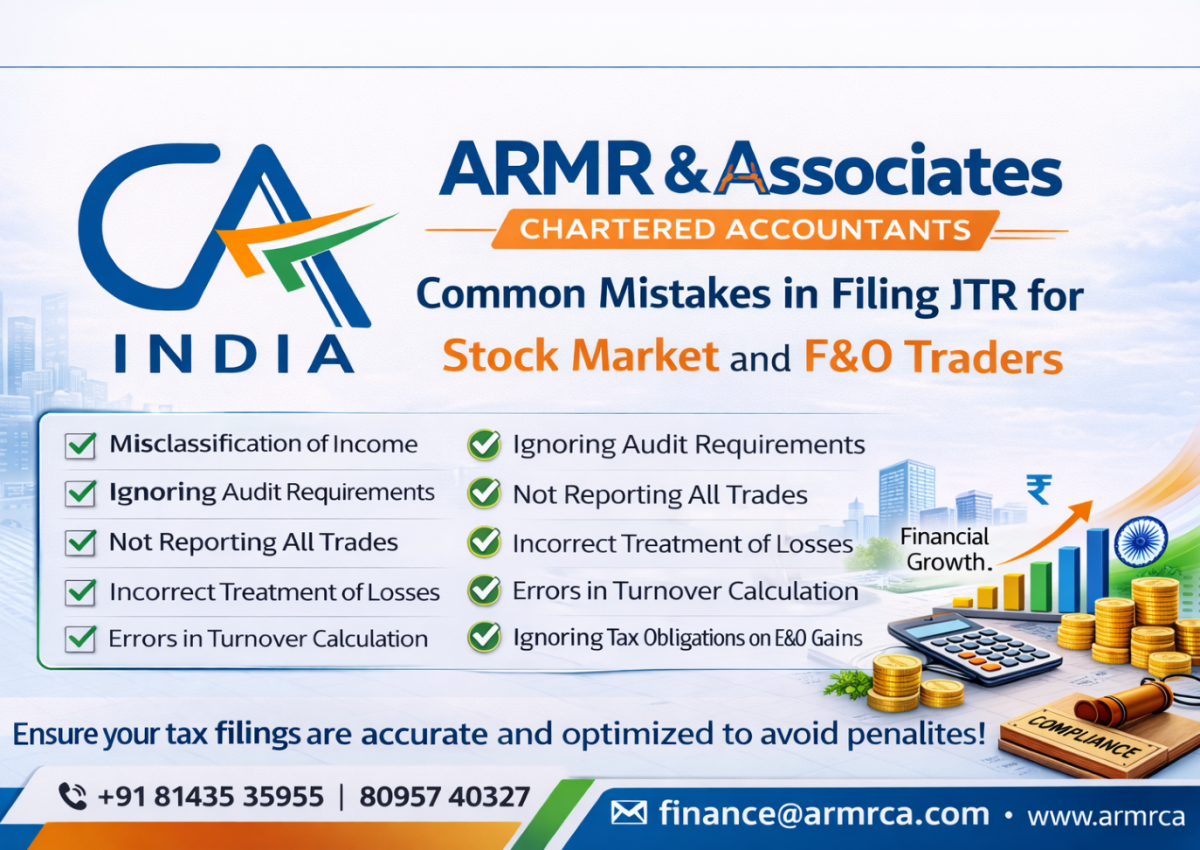
India has seen a sharp rise in equity, intraday and derivatives trading in recent years. While trading apps and online platforms have made it easy to enter the markets, most taxpayers still struggle to correctly report these transactions in their Income Tax Returns (ITR). Errors in classification, form selection and disclosure often result in defective returns, loss of carry-forward benefits and, in some cases, scrutiny or reassessment.
1. Treating Active Trading as Investment Income
One of the most fundamental mistakes is reporting active trading income under “Capital Gains” instead of “Profits and Gains from Business or Profession”.
How this typically happens
- Intraday trades are disclosed as short-term capital gains.
- F&O positions are reported in Schedule CG as if they were delivery-based investments.
- A high-churn, leveraged trading book is clubbed with long-term investments.
Why this is a red flag
- The head of income determines the tax rate, set-off and carry-forward rules, and disclosure pattern in the ITR.
- High-frequency, leveraged trading shown as “investment” can be inconsistent with data available through brokers, depositories and AIS.
- Misclassification increases the probability of queries, especially when trading volumes are material.
Recommended approach
- Treat genuine long-term holdings (with clear investment intent) as capital assets.
- Treat intraday equity as speculative business income and F&O derivatives (subject to product-specific rules) as non-speculative business income.
- Document a clear policy distinguishing “investment” and “trading” portfolios and apply it consistently each year.
2. Selecting an Inappropriate ITR Form
Many traders focus on “getting the return filed” and overlook whether the right ITR form is being used. An incorrect form can render the return defective.
Common missteps
- Filing ITR-1 or ITR-2 even when there is business income from F&O or intraday.
- Using forms meant for salary and capital gains only, while substantial trading business exists.
- Opting for ITR-4 (presumptive taxation) without understanding eligibility and consequences.
Consequences
- The return may be treated as defective under section 139(9), requiring rectification within a limited time frame.
- Inconsistent form usage across years can affect the credibility of disclosures and invite further verification.
Recommended approach
- For individuals/HUFs with business income from trading (F&O or intraday), ITR-3 is generally the appropriate form.
- ITR-2 may be suitable where there is no business income, only capital gains from delivery-based investments plus salary/other income.
- Always refer to the latest official instructions to ITR forms for the relevant assessment year before filing.
3. Miscomputing Turnover for F&O and Intraday
Turnover for income-tax purposes in derivatives and intraday trading is a specialised concept and cannot be equated with traded or contract value.
Frequent errors
- Treating the entire contract value of F&O trades as “turnover”.
- Ignoring loss transactions while calculating turnover.
- Simply lifting “total turnover” or “traded value” from broker reports without adjustments.
Conceptual position
- For F&O, turnover is generally computed as the aggregate of absolute profits and losses across all trades, not the notional contract value.
- For intraday equity, turnover is similarly based on the absolute difference in each trade outcome.
- Delivery-based investment transactions follow a separate framework where “turnover” is relevant only if they form part of a trading business.
Recommended approach
- Adopt an ICAI-aligned methodology for turnover computation and document it clearly in your working papers.
- Use broker data as a base, but reconcile and adjust it to reflect income-tax concepts accurately.
4. Misuse of Presumptive Taxation (Sections 44AD / 44ADA)
Presumptive taxation provisions are attractive for small businesses, but their casual use by F&O traders is a recurring area of concern.
Typical misuse patterns
- Applying section 44ADA to F&O trading, although it is meant for specified professions.
- Opting for section 44AD without accurately computing turnover or considering long-term implications of opting in and out.
- Declaring arbitrary profit percentages that bear little relation to actual results, solely to avoid books and audit.
Risks involved
- Ineligible use of presumptive sections can invite detailed verification or adjustment.
- Artificially inflating income under presumptive schemes can lead to unnecessary tax outflow and permanent loss of genuine losses and carry-forward.
- Once presumptive taxation is adopted and later discontinued, additional conditions may apply to subsequent years.
Recommended approach
- Evaluate presumptive schemes only after a detailed turnover and risk analysis, and only where clearly eligible.
- Material or high-frequency F&O activity is better treated as a regular business with proper books and audited results where required.
5. Incomplete Reporting of Trading Accounts and Brokers
With multiple demat and trading platforms available, it is common for traders to use more than one broker – and equally common to omit some accounts in tax computations.
How this happens
- Only the main broker statement is shared with the tax preparer; secondary accounts are overlooked.
- Old or dormant accounts with small holdings or losses are ignored.
- Overseas trading accounts (for US equities/options) are not reported at all.
Why this is serious
- Brokers, depositories and financial institutions report data that feeds into AIS and other department systems.
- Non-reporting or under-reporting trades can lead to mismatches between AIS and ITR, triggering automated notices.
- Ignoring loss-making accounts also deprives the taxpayer of legitimate set-off and carry-forward.
Recommended approach
- Compile annual P&L and ledger statements for every demat/trading account, including closed or inactive ones.
- Reconcile broker-wise data with AIS and Form 26AS before finalising the return.
- In case of foreign trading accounts, ensure that income and foreign asset disclosures (e.g., Schedule FA) are completed where applicable.
6. Skipping AIS and Form 26AS Reconciliation
Filing the ITR without reviewing AIS (Annual Information Statement) and Form 26AS is a frequent and avoidable error.
Common issues
- AIS reflects substantial securities transactions while the ITR shows minimal or no trading income.
- TDS entries on interest, professional fees or other receipts are not captured in the computation.
- Redemptions of mutual funds or bonds reflected in AIS are missing in capital gains schedules.
Recommended approach
- Always download AIS and Form 26AS at the outset of the filing process.
- Perform a transaction-wise reconciliation of AIS with broker statements and bank accounts and document any genuine discrepancies.
- Where AIS appears inaccurate, record the rationale for the figures adopted in the return and preserve supporting documentation.
7. Not Distinguishing Speculative and Non-Speculative Business Income
Although both intraday equity and F&O results may be business income, their classification is different for tax purposes.
Typical mistakes
- Combining intraday and F&O results into a single business figure for convenience.
- Showing all trading results as non-speculative business income.
- Omitting the separate disclosure of speculative losses in the ITR.
Why this matters
- Speculative and non-speculative losses are subject to distinct set-off and carry-forward rules under the Act.
- Misclassification can lead to incorrect tax benefit and later denial during scrutiny or rectification proceedings.
Recommended approach
- Prepare separate computation sheets for:
- Speculative business – typically intraday equity trades, and
- Non-speculative business – typically F&O derivatives.
- Ensure that the ITR schedules and loss carry-forward statements mirror this segregation accurately.
8. Losing Carry-Forward of Losses Due to Delayed or Defective Filing
For traders, the value of correctly preserving losses for future set-off can be substantial.
How benefits are lost
- Filing the return after the original due date in a year where trading losses are significant.
- Using a wrong ITR form that is later treated as defective, without timely correction.
- Omitting to fill the loss schedules or reporting losses under incorrect heads.
Consequences
- Business and capital losses that could have reduced future tax outgo are permanently forfeited.
- The overall tax burden over the trader’s lifecycle becomes materially higher.
Recommended approach
- Adhere to the original due date where carry-forward of losses is desired.
- Confirm that all relevant loss schedules in the ITR are duly filled, with correct head-wise and year-wise details.
- Maintain a structured “loss register” tracking each year’s losses and their utilisation.
9. Weak Documentation and Absence of Working Papers
Strong documentation is a hallmark of robust tax compliance, particularly for traders with high transaction volume.
Common gaps
- No consolidated working file bridging broker reports to the final ITR figures.
- No evidence of expenses such as internet, trading software, research/advisory fees and equipment, which are otherwise allowable business deductions.
- Dependence only on year-end summary statements without contract-level backups.
Recommended approach
- Maintain an annual computation workbook that consolidates broker-wise P&L, turnover, and claimable expenses, linked to underlying documents.
- Download and securely store year-end statements, ledgers and contract notes from each broker.
- Record the methodology used for turnover calculation, expense allocation and classification of trades, and retain it with your tax file.
10. Overlooking Tax Audit and Books-of-Account Requirements
As turnover and volume grow, traders often cross thresholds that trigger tax audit and books-of-account obligations without realising it.
Common misconceptions
- Assuming tax audits apply “only to big companies”, not to individuals.
- Miscomputing turnover and thus wrongly concluding that tax audit is not applicable.
- Not maintaining any systematic books of account despite substantial business income.
Recommended approach
- Compute turnover as per accepted guidance and review it against current tax audit thresholds for each year.
- Where audit is applicable, complete the audit and upload the audit report before filing the ITR.
- Maintain appropriate books of account and supporting records proportionate to the scale and complexity of trading activity.
11. Assuming “No Net Tax” Means “No Compliance Risk”
Many traders believe that if there is no net tax payable due to losses or low income, they can take a relaxed approach to filing.
Why this approach is flawed
- Losses that are not correctly reported cannot be carried forward for future set-off.
- High trading volume with poor or no reporting can still be flagged as a risk by data analytics systems.
- Non-filing or casual filing habits can complicate future years when incomes rise or when credit, visa or regulatory due diligence is undertaken.
Recommended approach
- File a complete and accurate ITR even in loss years, particularly when trading volumes are significant.
- Treat trading as a business activity with commensurate seriousness in record-keeping and compliance, not merely as a side hobby.
How a Chartered Accountant Adds Value for Traders
The interaction between classification rules, turnover computation, audit thresholds and evolving disclosure requirements makes ITR filing for traders more complex than a standard salary return. Engaging a Chartered Accountant familiar with stock market and F&O nuances can help you:
- Determine the appropriate head of income and ITR form.
- Compute turnover and business results in line with recognised guidance.
- Evaluate and comply with tax audit and books-of-account requirements.
- Preserve and optimise set-off and carry-forward of losses.
- Reconcile broker data with AIS, Form 26AS and bank statements to minimise mismatch-based notices.
A disciplined, professionally guided approach ensures that your focus remains on trading decisions, not on firefighting tax notices.
About ARMR & Associates
ARMR & Associates, Chartered Accountants, is a Chennai-based firm with a specialised focus on capital markets taxation, GST, and business advisory for individuals and growing enterprises. The firm regularly advises intraday and F&O traders, proprietary trading outfits and market professionals on structuring their activities, meeting tax audit and reporting obligations, and optimising loss set-off and carry-forward within the framework of Indian tax laws.
Combining deep technical expertise with practical market understanding, ARMR & Associates delivers end-to-end support – from planning and documentation to ITR filing and representation – to help clients trade with confidence and remain compliant.
