

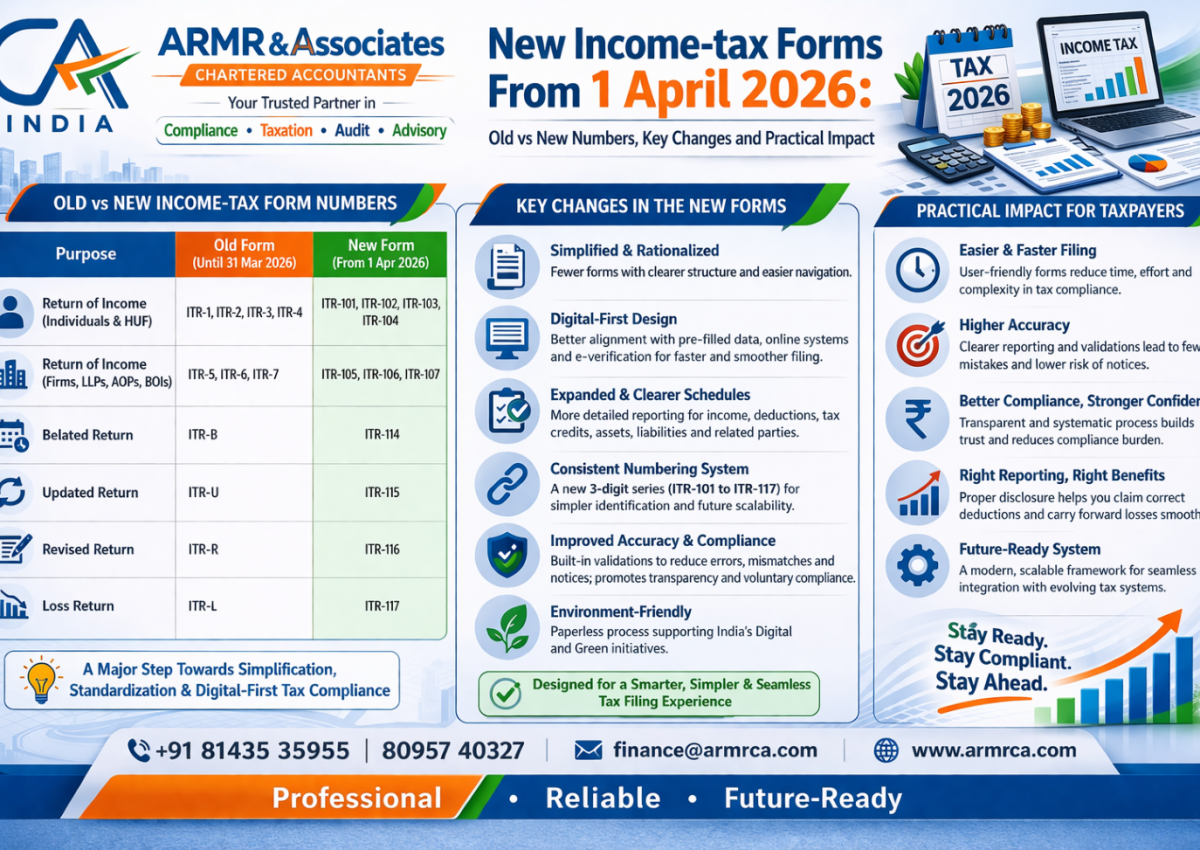
From 1 April 2026, the Income‑tax compliance landscape is changing significantly. The new Income‑tax Act, 2025 and Income‑tax Rules, 2026 introduce a completely refreshed set of form numbers, along with important changes in the information to be reported.
This article gives a clear, side‑by‑side comparison of old vs new income‑tax forms, highlights key changes that matter to taxpayers and businesses, and lists practical action points before the new regime goes live.
1. Why have income‑tax forms changed?
The Central Board of Direct Taxes (CBDT) has overhauled the rules and forms with three main objectives:
- Simplify language and structure of the Rules.
- Rationalise and reduce the number of forms and overlaps.
- Align all forms to the new Income‑tax Act, 2025 and to current compliance practices (AIS, TDS/TCS, international tax, high‑value transactions, etc.).
Practically, you will see:
- New three‑digit form numbers in many areas.
- Consolidation of multiple forms into a single composite form.
- Additional data points demanded in old‑familiar compliances like HRA, rent, tax audit, TDS/TCS returns, PAN and FTC.
For professionals and taxpayers, the core law may feel familiar, but the form numbers and reporting requirements will look very different from 1 April 2026.
2. Old vs new form numbers – at a glance
The heart of this article is the mapping from the earlier forms (valid up to 31 March 2026) to the new forms (applicable from 1 April 2026). Use this section while updating your internal checklists, templates and ERP or payroll software.
2.1 Salary, HRA and individual compliance forms
| Purpose | Old form (till 31‑03‑2026) | New form (from 01‑04‑2026) | Key change / remark |
| Tax relief on salary arrears / advance | Form 10E | Form 39 | Same purpose, minor format changes. |
| Deduction for rent paid (no HRA – section 80GG) | Form 10BA | Form 31 | Landlord PAN mandatory; separate disclosure of cash vs banking‑channel rent; Tax Year & contact details added. |
| Medical authority certificate for disability (80U / 80DD) | Form 10‑IA | Form 30 | Similar content; timing and filing requirements reiterated. |
| Employee investment and deduction declaration to employer | Form 12BB | Form 124 | Additional disclosures including relationship with landlord for HRA under old tax regime. |
| Detailed perquisite statement | Form 12BA | Form 123 | Similar content with updated references. |
How this affects salaried employees and employers
- Employees will need to give more granular information to the employer, especially for HRA and rent‑related claims.
- Payroll teams must redesign their investment declaration formats and HR portals to capture the new mandatory details.
2.2 AIS / 26AS and information reporting
| Purpose | Old form | New form | Key change / remark |
| Annual Information Statement / tax credit statement | Form 26AS (along with AIS/ TIS) | Form 168 | PAN‑based statement continues; Aadhaar will not be displayed; layout aligned to new three‑digit format. |
For taxpayers, the portal view will remain similar, but backend references, exports and notices will start referring to Form 168 instead of 26AS.
2.3 Declarations for no‑TDS on interest – senior citizens and small depositors
| Purpose | Old forms | New form | Key change / remark |
| Self‑declaration for non‑deduction of TDS on interest etc. | Form 15G / Form 15H | Form 121 | Both combined into one form; disclosure of ITR filing status for last two Tax Years is required. |
Key implications:
- Banks and other deductors get a single, standard declaration format.
- Individuals claiming no‑TDS must be ready to quote their filing history, which will discourage misuse by habitual non‑filers.
2.4 TDS / TCS returns and one‑time TDS filings
| Purpose | Old form (till 31‑03‑2026) | New form (from 01‑04‑2026) | Key change / remark |
| Quarterly TDS return – salaries | Form 24Q | Form 138 | Major structural changes; mapping to new sections and form numbers. |
| Quarterly TDS return – non‑salary domestic payments | Form 26Q | Form 140 | Major structural changes; additional fields expected. |
| Quarterly TDS return – non‑resident payments | Form 27Q | Form 144 | Major structural changes; better capture of treaty‑related details. |
| Quarterly TCS return | Form 27EQ | Form 143 | New layout and fields aligned to TCS provisions under the new Act. |
| One‑time TDS for property, rent, JDA, professional fee, VDA etc. | Forms 26QB / 26QC / 26QD / 26QE | Form 141 | Multiple separate forms consolidated into one composite form, covering multiple types of specified transactions. |
Practical notes
- Deductors and TDS return filers must upgrade their software to support the 138–144 series.
- For property and similar transactions, instead of choosing among multiple forms, deductors will now file a single Form 141, selecting the relevant nature of payment and section.
2.5 TDS / TCS certificates
| Purpose | Old form | New form | Key change / remark |
| Salary TDS certificate to employees | Form 16 | Form 130 | Same purpose; employer contact details and rate of deduction printed more prominently. |
| TDS certificate for non‑salary payments | Form 16A | Form 131 | Same purpose; more structured fields for nature of payment and section code. |
| TDS certificate for specified one‑time transactions (property, rent, JDA, VDA, etc.) | Forms 16B / 16C / 16D / 16E | Form 132 | Consolidated into a single certificate format. |
| TCS certificate | Form 27D | Form 133 | Similar purpose with updated references and layout. |
For employees and deductees, the certificates will look more standardised and should be easier to reconcile with AIS / Form 168.
2.6 PAN, TAN and KYC‑linked forms
| Purpose | Old form | New form | Key change / remark |
| TAN application (deductors / collectors) | Form 49B(1) / 49B(2) | Forms 134 / 135 | Largely similar; renumbered; certain classification fields refined. |
| PAN application – Indian citizens / entities | Form 49A | Forms 93 / 95 | Additional documentation tightening; for individuals born on or after 1‑10‑2023, birth certificate is mandatory for date of birth. |
| PAN application – foreign citizens / foreign entities | Form 49AA | Forms 94 / 96 | Revised categories for foreign individual, PIO, OCI and foreign entities; passport and foreign address details made more critical. |
Coupled with changes in “transactions mandatorily requiring PAN”, this will have a direct impact on real estate, high‑value cash transactions, event and hotel bills, cash deposits/withdrawals and similar payments.
2.7 International tax and tax audit forms
| Purpose | Old form | New form | Key change / remark |
| Foreign Tax Credit (FTC) claim | Form 67 | Form 44 | Foreign TIN mandatory; accountant’s certificate required where FTC exceeds specified thresholds or for companies. |
| Tax audit report | Form 3CA‑3CD / 3CB‑3CD | Form 26 | Clauses expanded (e.g., from 44 to 55); more granular disclosures for turnover, VDA, foreign income, TCS, reconciliations, etc. |
These changes will increase documentation and working requirements for tax audits and cross‑border taxpayers.
3. Thematic changes that matter in day‑to‑day practice
Instead of only memorising new numbers, it is important to understand the practical themes behind the restructuring.
3.1 Salary, HRA and rent‑related disclosures
- The list of cities eligible for a higher HRA exemption slab (50% of salary) has been expanded to include large metropolitan cities beyond the traditional four.
- New Form 124 (old Form 12BB) places more emphasis on full disclosure of landlord details and relationship, especially where rent is paid to a related party.
- New Form 31 (old Form 10BA) requires clear breakup of rent paid in cash vs through banking channels and insists on landlord PAN.
This means employees should prepare proper rent documentation (rent agreements, bank proofs, PAN of landlord) well in advance, and employers should update payroll software and HR communication.
3.2 Declarations and small investor compliance
- By merging Forms 15G and 15H into a single Form 121, the department has simplified the format but tightened controls by linking it with ITR filing status.
- Senior citizens and small depositors need to understand that incorrect or casual filing of Form 121 can now be more easily flagged and cross‑verified.
Educating bank customers and elderly clients on when and how to use Form 121 will be an important advisory area.
3.3 TDS / TCS compliance and certificates
- New return series (Forms 138–144) and certificates (Forms 130–133) aim to create a consistent, three‑digit regime.
- The consolidation of one‑time TDS forms into Form 141 and certificates into Form 132 reduces confusion for occasional deductors (such as individual buyers of property), but the form itself will be more comprehensive.
For corporates and CAs, this is the right time to:
- Align section codes, nature‑of‑payment mapping and challan details in ERP.
- Update checklists for quarterly TDS/TCS filing and reconciliation.
- Train staff on the new numbering and cross‑reference system.
3.4 PAN, KYC and high‑value transactions
The new form regime goes hand‑in‑hand with updated rules on:
- Which transactions mandatorily require PAN.
- Thresholds for hotel/event payments, property transactions, large cash deposits/withdrawals, and specified financial transactions.
- Documentation requirements for PAN applications, especially for minors, new‑borns and foreign taxpayers.
Real estate developers, brokers, hotels, event managers and banks should revisit their KYC processes to ensure they capture the correct PAN and documentation at the time of booking/transaction.
3.5 Tax audit and international tax
- Tax audit Form 26 is more detailed, and the expectation from auditors is correspondingly higher in terms of reconciliations, break‑ups and reporting of non‑compliance.
- Taxpayers claiming Foreign Tax Credit (Form 44) must take special care to collect foreign tax deduction certificates, foreign TIN, proof of payment and supporting computations in time.
From a professional standpoint, it is advisable to:
- Redesign audit programmes and FTC working papers.
- Update engagement letters to reflect the additional data and documentation required from clients.
4. Action checklist before 1 April 2026
For an easy transition to the new forms, consider the following steps:
- Update internal documentation
- Replace old form numbers in letters, checklists, process notes and templates with the new numbers.
- Maintain a one‑page “old vs new forms” chart at your office and on your intranet.
- Upgrade software and tools
- Coordinate with payroll, accounting and TDS software providers for updates reflecting Forms 26, 39, 31, 121, 130–144, 168, etc.
- Test generation and validation of new‑series forms where utilities are already available.
- Client communication and training
- Share concise email alerts or FAQs with clients explaining major form changes relevant to them (HRA, Form 121, new TDS certificates, one‑time property TDS, PAN/KYC).
- Train internal teams and client staff handling payroll, vendor payments, and finance on new numbers and data fields.
- Dry run for first quarter
- For Q1 of Tax Year 2026‑27, run internal mock reconciliations using both old and new references to ensure there are no gaps.
- Pay special attention to property transactions, high‑value cash transactions and cross‑border payments.
5. Conclusion
The shift to the new Income‑tax forms from 1 April 2026 is not just a cosmetic renumbering exercise. It reflects a broader push towards better data quality, wider information reporting, and tighter linkage between forms, PAN, AIS and return processing.
Taxpayers, employers, deductors and professionals who proactively adapt their systems and documentation to the new form regime in the coming weeks will find the transition smoother and less error‑prone.From 1 April 2026, the Income‑tax compliance landscape is changing significantly. The new Income‑tax Act, 2025 and Income‑tax Rules, 2026 introduce a completely refreshed set of form numbers, along with important changes in the information to be reported.
This article gives a clear, side‑by‑side comparison of old vs new income‑tax forms, highlights key changes that matter to taxpayers and businesses, and lists practical action points before the new regime goes live.
1. Why have income‑tax forms changed?
The Central Board of Direct Taxes (CBDT) has overhauled the rules and forms with three main objectives:
- Simplify language and structure of the Rules.
- Rationalise and reduce the number of forms and overlaps.
- Align all forms to the new Income‑tax Act, 2025 and to current compliance practices (AIS, TDS/TCS, international tax, high‑value transactions, etc.).
Practically, you will see:
- New three‑digit form numbers in many areas.
- Consolidation of multiple forms into a single composite form.
- Additional data points demanded in old‑familiar compliances like HRA, rent, tax audit, TDS/TCS returns, PAN and FTC.
For professionals and taxpayers, the core law may feel familiar, but the form numbers and reporting requirements will look very different from 1 April 2026.
2. Old vs new form numbers – at a glance
The heart of this article is the mapping from the earlier forms (valid up to 31 March 2026) to the new forms (applicable from 1 April 2026). Use this section while updating your internal checklists, templates and ERP or payroll software.
2.1 Salary, HRA and individual compliance forms
| Purpose | Old form (till 31‑03‑2026) | New form (from 01‑04‑2026) | Key change / remark |
| Tax relief on salary arrears / advance | Form 10E | Form 39 | Same purpose, minor format changes. |
| Deduction for rent paid (no HRA – section 80GG) | Form 10BA | Form 31 | Landlord PAN mandatory; separate disclosure of cash vs banking‑channel rent; Tax Year & contact details added. |
| Medical authority certificate for disability (80U / 80DD) | Form 10‑IA | Form 30 | Similar content; timing and filing requirements reiterated. |
| Employee investment and deduction declaration to employer | Form 12BB | Form 124 | Additional disclosures including relationship with landlord for HRA under old tax regime. |
| Detailed perquisite statement | Form 12BA | Form 123 | Similar content with updated references. |
How this affects salaried employees and employers
- Employees will need to give more granular information to the employer, especially for HRA and rent‑related claims.
- Payroll teams must redesign their investment declaration formats and HR portals to capture the new mandatory details.
2.2 AIS / 26AS and information reporting
| Purpose | Old form | New form | Key change / remark |
| Annual Information Statement / tax credit statement | Form 26AS (along with AIS/ TIS) | Form 168 | PAN‑based statement continues; Aadhaar will not be displayed; layout aligned to new three‑digit format. |
For taxpayers, the portal view will remain similar, but backend references, exports and notices will start referring to Form 168 instead of 26AS.
2.3 Declarations for no‑TDS on interest – senior citizens and small depositors
| Purpose | Old forms | New form | Key change / remark |
| Self‑declaration for non‑deduction of TDS on interest etc. | Form 15G / Form 15H | Form 121 | Both combined into one form; disclosure of ITR filing status for last two Tax Years is required. |
Key implications:
- Banks and other deductors get a single, standard declaration format.
- Individuals claiming no‑TDS must be ready to quote their filing history, which will discourage misuse by habitual non‑filers.
2.4 TDS / TCS returns and one‑time TDS filings
| Purpose | Old form (till 31‑03‑2026) | New form (from 01‑04‑2026) | Key change / remark |
| Quarterly TDS return – salaries | Form 24Q | Form 138 | Major structural changes; mapping to new sections and form numbers. |
| Quarterly TDS return – non‑salary domestic payments | Form 26Q | Form 140 | Major structural changes; additional fields expected. |
| Quarterly TDS return – non‑resident payments | Form 27Q | Form 144 | Major structural changes; better capture of treaty‑related details. |
| Quarterly TCS return | Form 27EQ | Form 143 | New layout and fields aligned to TCS provisions under the new Act. |
| One‑time TDS for property, rent, JDA, professional fee, VDA etc. | Forms 26QB / 26QC / 26QD / 26QE | Form 141 | Multiple separate forms consolidated into one composite form, covering multiple types of specified transactions. |
Practical notes
- Deductors and TDS return filers must upgrade their software to support the 138–144 series.
- For property and similar transactions, instead of choosing among multiple forms, deductors will now file a single Form 141, selecting the relevant nature of payment and section.
2.5 TDS / TCS certificates
| Purpose | Old form | New form | Key change / remark |
| Salary TDS certificate to employees | Form 16 | Form 130 | Same purpose; employer contact details and rate of deduction printed more prominently. |
| TDS certificate for non‑salary payments | Form 16A | Form 131 | Same purpose; more structured fields for nature of payment and section code. |
| TDS certificate for specified one‑time transactions (property, rent, JDA, VDA, etc.) | Forms 16B / 16C / 16D / 16E | Form 132 | Consolidated into a single certificate format. |
| TCS certificate | Form 27D | Form 133 | Similar purpose with updated references and layout. |
For employees and deductees, the certificates will look more standardised and should be easier to reconcile with AIS / Form 168.
2.6 PAN, TAN and KYC‑linked forms
| Purpose | Old form | New form | Key change / remark |
| TAN application (deductors / collectors) | Form 49B(1) / 49B(2) | Forms 134 / 135 | Largely similar; renumbered; certain classification fields refined. |
| PAN application – Indian citizens / entities | Form 49A | Forms 93 / 95 | Additional documentation tightening; for individuals born on or after 1‑10‑2023, birth certificate is mandatory for date of birth. |
| PAN application – foreign citizens / foreign entities | Form 49AA | Forms 94 / 96 | Revised categories for foreign individual, PIO, OCI and foreign entities; passport and foreign address details made more critical. |
Coupled with changes in “transactions mandatorily requiring PAN”, this will have a direct impact on real estate, high‑value cash transactions, event and hotel bills, cash deposits/withdrawals and similar payments.
2.7 International tax and tax audit forms
| Purpose | Old form | New form | Key change / remark |
| Foreign Tax Credit (FTC) claim | Form 67 | Form 44 | Foreign TIN mandatory; accountant’s certificate required where FTC exceeds specified thresholds or for companies. |
| Tax audit report | Form 3CA‑3CD / 3CB‑3CD | Form 26 | Clauses expanded (e.g., from 44 to 55); more granular disclosures for turnover, VDA, foreign income, TCS, reconciliations, etc. |
These changes will increase documentation and working requirements for tax audits and cross‑border taxpayers.
3. Thematic changes that matter in day‑to‑day practice
Instead of only memorising new numbers, it is important to understand the practical themes behind the restructuring.
3.1 Salary, HRA and rent‑related disclosures
- The list of cities eligible for a higher HRA exemption slab (50% of salary) has been expanded to include large metropolitan cities beyond the traditional four.
- New Form 124 (old Form 12BB) places more emphasis on full disclosure of landlord details and relationship, especially where rent is paid to a related party.
- New Form 31 (old Form 10BA) requires clear breakup of rent paid in cash vs through banking channels and insists on landlord PAN.
This means employees should prepare proper rent documentation (rent agreements, bank proofs, PAN of landlord) well in advance, and employers should update payroll software and HR communication.
3.2 Declarations and small investor compliance
- By merging Forms 15G and 15H into a single Form 121, the department has simplified the format but tightened controls by linking it with ITR filing status.
- Senior citizens and small depositors need to understand that incorrect or casual filing of Form 121 can now be more easily flagged and cross‑verified.
Educating bank customers and elderly clients on when and how to use Form 121 will be an important advisory area.
3.3 TDS / TCS compliance and certificates
- New return series (Forms 138–144) and certificates (Forms 130–133) aim to create a consistent, three‑digit regime.
- The consolidation of one‑time TDS forms into Form 141 and certificates into Form 132 reduces confusion for occasional deductors (such as individual buyers of property), but the form itself will be more comprehensive.
For corporates and CAs, this is the right time to:
- Align section codes, nature‑of‑payment mapping and challan details in ERP.
- Update checklists for quarterly TDS/TCS filing and reconciliation.
- Train staff on the new numbering and cross‑reference system.
3.4 PAN, KYC and high‑value transactions
The new form regime goes hand‑in‑hand with updated rules on:
- Which transactions mandatorily require PAN.
- Thresholds for hotel/event payments, property transactions, large cash deposits/withdrawals, and specified financial transactions.
- Documentation requirements for PAN applications, especially for minors, new‑borns and foreign taxpayers.
Real estate developers, brokers, hotels, event managers and banks should revisit their KYC processes to ensure they capture the correct PAN and documentation at the time of booking/transaction.
3.5 Tax audit and international tax
- Tax audit Form 26 is more detailed, and the expectation from auditors is correspondingly higher in terms of reconciliations, break‑ups and reporting of non‑compliance.
- Taxpayers claiming Foreign Tax Credit (Form 44) must take special care to collect foreign tax deduction certificates, foreign TIN, proof of payment and supporting computations in time.
From a professional standpoint, it is advisable to:
- Redesign audit programmes and FTC working papers.
- Update engagement letters to reflect the additional data and documentation required from clients.
4. Action checklist before 1 April 2026
For an easy transition to the new forms, consider the following steps:
- Update internal documentation
- Replace old form numbers in letters, checklists, process notes and templates with the new numbers.
- Maintain a one‑page “old vs new forms” chart at your office and on your intranet.
- Upgrade software and tools
- Coordinate with payroll, accounting and TDS software providers for updates reflecting Forms 26, 39, 31, 121, 130–144, 168, etc.
- Test generation and validation of new‑series forms where utilities are already available.
- Client communication and training
- Share concise email alerts or FAQs with clients explaining major form changes relevant to them (HRA, Form 121, new TDS certificates, one‑time property TDS, PAN/KYC).
- Train internal teams and client staff handling payroll, vendor payments, and finance on new numbers and data fields.
- Dry run for first quarter
- For Q1 of Tax Year 2026‑27, run internal mock reconciliations using both old and new references to ensure there are no gaps.
- Pay special attention to property transactions, high‑value cash transactions and cross‑border payments.
5. Conclusion
The shift to the new Income‑tax forms from 1 April 2026 is not just a cosmetic renumbering exercise. It reflects a broader push towards better data quality, wider information reporting, and tighter linkage between forms, PAN, AIS and return processing.
Taxpayers, employers, deductors and professionals who proactively adapt their systems and documentation to the new form regime in the coming weeks will find the transition smoother and less error‑prone.
