

GST Update | 1 October 2026
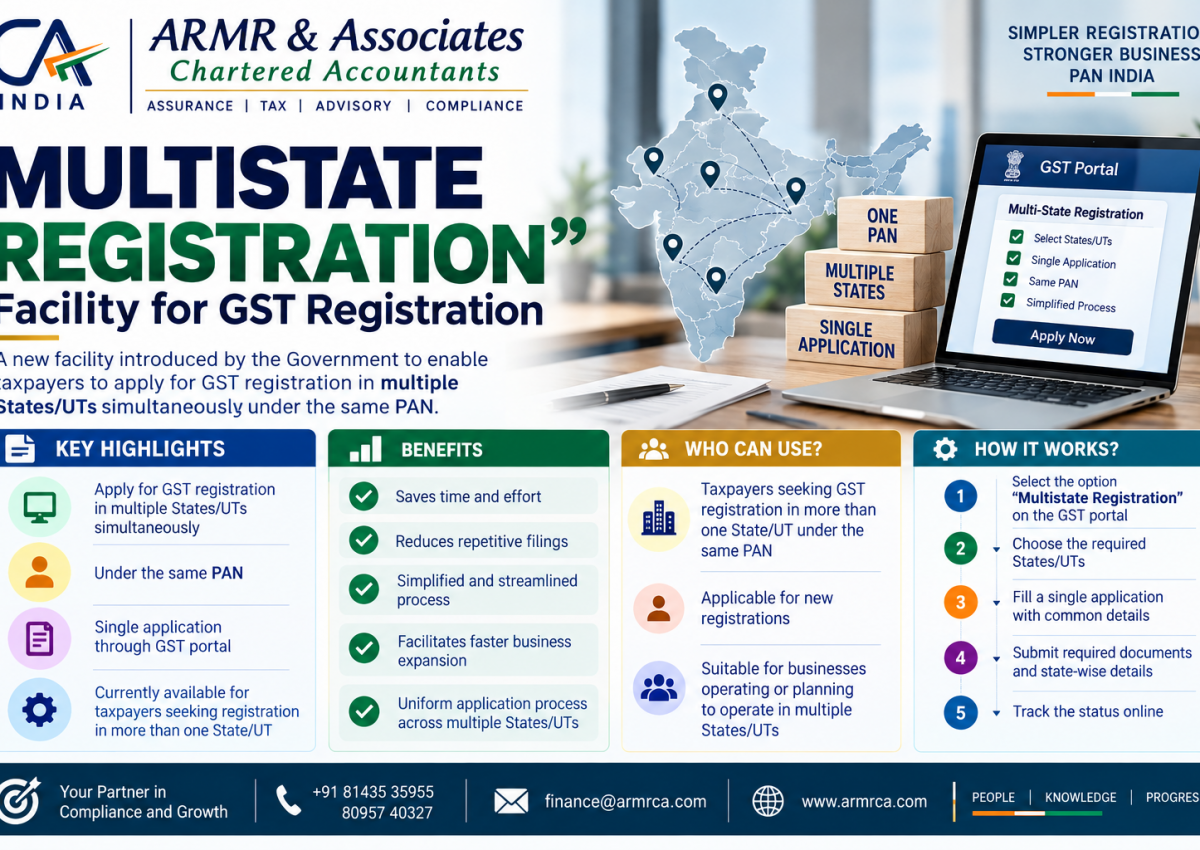
The Goods and Services Tax Network (GSTN) has introduced a new “Multistate Registration” facility on the GST Common Portal to simplify the process of obtaining GST registrations in multiple States and Union Territories under the same Permanent Account Number (PAN).
The new functionality is intended to reduce repetitive data entry and streamline the GST registration process for businesses having operations across multiple States or Union Territories.
As of now, the facility is available only for Normal Taxpayers.
What is the GST Multistate Registration Facility?
Under the existing GST registration mechanism, a taxpayer requiring registration in multiple States is required to initiate and complete separate registration applications for each State.
Although the registrations remain State-specific, several particulars are common across these applications, including:
- Business and constitution details
- Promoter/Partner details
- Authorised Signatory details
- Authorised Representative details
- Details of Goods and Services
The newly introduced Multistate Registration facility allows taxpayers to provide such common information centrally through a Common Registration Information (CRI) process.
The common information is then carried forward to the individual State/UT registration applications, thereby reducing duplication and improving the efficiency of the registration process.
How Does the Multistate Registration Process Work?
The process involves a common initial application followed by completion of State-specific requirements.
1. Selection of Multiple States/UTs
A new “Multistate Registration” option is available on the GST Common Portal.
The applicant can select all the States/Union Territories in which GST registration is required under the same PAN.
For example, a business expanding its operations to Karnataka, Telangana, Andhra Pradesh and Maharashtra can select all four States at the initial stage.
2. Generation of Master TRN
After selecting the required States/UTs, the GST Portal generates a Master Temporary Reference Number (TRN).
This Master TRN is used to provide the common registration information applicable to the selected registrations.
3. Submission of Common Registration Information (CRI)
Using the Master TRN, the applicant is required to provide the Common Registration Information (CRI).
The CRI covers common particulars such as:
- Business Details
- Promoters/Partners
- Authorised Signatory
- Authorised Representative
- Goods and Services
The Master TRN must be submitted within 15 days.
This timeline should be carefully monitored by taxpayers and professionals handling the registration process.
4. Generation of Individual TRNs
Once the CRI is successfully submitted, the GST Portal generates individual TRNs for each selected State/UT.
The common information already furnished through the CRI is automatically populated in the respective State/UT registration applications.
Importantly, this information remains editable, allowing the applicant to review and make necessary corrections before submission.
5. Completion of State-Specific Information
The applicant must thereafter complete the information specific to each State/UT.
This includes, among other requirements:
- Principal Place of Business (PPoB)
- Additional Place of Business (APoB)
- State-specific information
- Aadhaar authentication
- Other information/documents required for the respective registration
Therefore, while the common information is streamlined, the applicant must continue to complete the State-wise requirements separately.
What Information is Common and What Remains State-Specific?
A clear distinction should be made between common registration information and State-specific information.
| Common Information | State-Specific Information |
| Business Details | Principal Place of Business |
| Promoter/Partner Details | Additional Place of Business |
| Authorised Signatory | State-specific particulars |
| Authorised Representative | Aadhaar authentication |
| Goods and Services | Other State-specific requirements |
Accordingly, the new facility does not create one single GST registration covering multiple States.
Each State/UT will continue to have its own GST registration. The facility merely simplifies the process of applying for those registrations.
Key Benefits of the New Facility
The Multistate Registration facility is particularly beneficial for businesses having a presence across several States.
Reduced Repetitive Data Entry
Businesses no longer need to repeatedly enter the same common information for each State registration application.
Better Consistency
Since common information is carried forward from the CRI, the possibility of inconsistencies in common particulars across different applications can be reduced.
Faster Registration Preparation
Taxpayers and GST practitioners can prepare multiple State registration applications more efficiently.
Ease of Business Expansion
Businesses expanding their operations into multiple States can benefit from a more streamlined registration process.
Improved User Experience
The functionality reduces procedural duplication and makes the GST registration process more convenient for taxpayers.
Important Points for Taxpayers
While the new facility simplifies the registration process, taxpayers should keep the following points in mind.
Separate State Registrations Continue to Apply
The Multistate Registration facility does not replace the requirement to obtain separate GST registrations in different States wherever registration is required.
State-Wise Details Must Be Verified
The applicant should carefully verify the Principal Place of Business, Additional Places of Business and other State-specific information before submitting each application.
Master TRN Timeline is Important
The Common Registration Information linked to the Master TRN must be submitted within 15 days.
Failure to complete the process within the prescribed period may affect the registration process.
Auto-Populated Information Should Be Reviewed
Although common information is automatically populated into individual TRNs, taxpayers should review the information carefully before submission.
Any discrepancy should be corrected before final submission.
Current Availability is Limited to Normal Taxpayers
As per the GSTN advisory dated 1 October 2026, the facility is currently available only for Normal Taxpayers.
Practical Impact for Businesses
The new facility will be particularly useful for businesses such as:
- Companies operating branch offices across multiple States
- Service providers with establishments in different States
- E-commerce and technology businesses
- Manufacturing companies with multiple locations
- Businesses expanding their operations nationally
- Companies setting up warehouses or other establishments in different States
For businesses undertaking rapid geographical expansion, the facility can substantially reduce the administrative effort involved in preparing multiple GST registration applications.
What Should Businesses Do Before Applying?
Businesses planning to use the Multistate Registration facility should keep the following information ready:
- PAN and constitution details of the business
- Details of promoters/partners
- Details of authorised signatory
- Details of authorised representative, wherever applicable
- Details of goods and services supplied
- Principal Place of Business documents for each State
- Additional Place of Business details, wherever applicable
- State-specific supporting documents
- Aadhaar authentication details
- Other documents required for GST registration
Preparing the information State-wise in advance can help ensure that the applications are completed smoothly after generation of the individual TRNs.
Conclusion
The introduction of the Multistate Registration facility is a significant step towards simplifying GST registration for businesses operating across multiple States and Union Territories.
The facility enables taxpayers to select multiple States/UTs, provide common registration information through a Master TRN and Common Registration Information (CRI), and subsequently complete the State-specific requirements through individual TRNs.
While separate GST registrations will continue to apply on a State-wise basis, the reduction in repetitive data entry can make the registration process more efficient, consistent and convenient.
Businesses planning expansion into multiple States should consider using the new functionality and ensure that the common as well as State-specific information is carefully reviewed before submission.
Key Takeaway
One common information process, followed by State-wise registration completion — making multi-State GST registration simpler and more efficient.
Source: GSTN Advisory dated 1 October 2026 – “Advisory on ‘Multistate Registration’ Facility for GST Registration”
Disclaimer
This article is intended for general informational purposes only and is based on the GSTN advisory available as on the date of publication. It should not be construed as professional or legal advice. Taxpayers should refer to the latest notifications, advisories, circulars and functionality available on the GST Common Portal before taking any action.
