

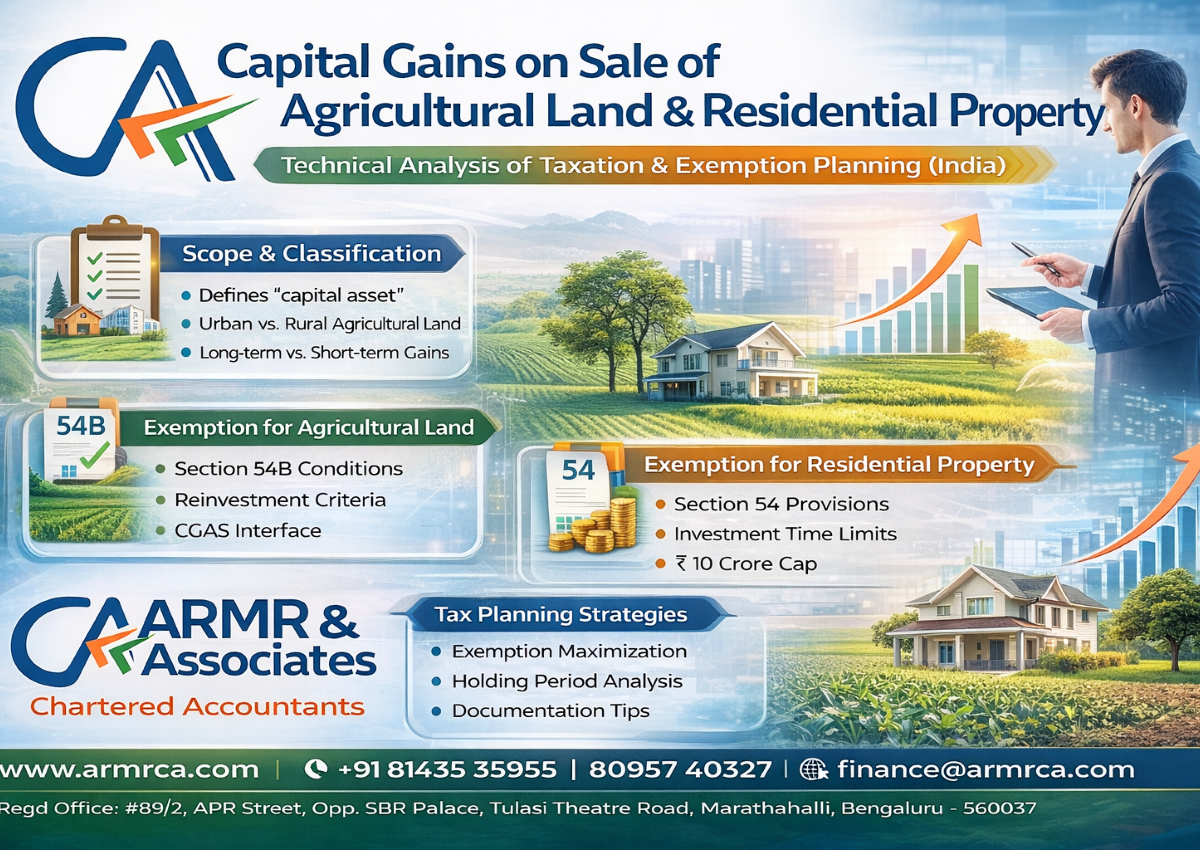
- Scope and basic classification
Capital gains arise under section 45 on transfer of a “capital asset” as defined in section 2(14). For immovable property, relevant categories are:
- Residential house property.
- Commercial land and building.
- Urban agricultural land (capital asset).
- Rural agricultural land (specifically excluded from “capital asset”).
Correct classification of the land as rural/urban and the gain as short‑term/long‑term is the foundation for any exemption planning.
- Rural vs urban agricultural land – section 2(14)
Rural agricultural land
- Rural agricultural land is excluded from the definition of “capital asset” under section 2(14)(iii), based on notified distance and population thresholds in relation to the nearest municipality/cantonment.
- Consequence:
- Transfer of such land is outside the scope of section 45; no capital gains charge arises.
- No question of claiming sections 54, 54B, 54F, 54EC on such surplus, as it is not “capital gain” at all.
- Best practice: still disclose major rural land sales in ITR (Schedule EI / note) for AIS/TIS reconciliation.
Urban agricultural land
- Agricultural land which does not qualify as “rural” is a capital asset.
- Sale proceeds are chargeable to capital gains as per section 45, with computation under section 48 read with section 49 (where applicable) and indexation as per the prevailing capital gains regime for immovable property.
- Once characterised as capital asset, exemption provisions of sections 54B, 54F, 54EC (and in some structures, 54/54D etc.) become relevant.
- Holding period and rate structure
- Immovable property (land or building or both), including urban agricultural land and residential houses:
- Short‑term capital asset: held for 24 months or less immediately preceding date of transfer.
- Long‑term capital asset: held for more than 24 months.
- Taxation:
- STCG: taxed at slab rates (no preferential rate).
- LTCG: taxed at concessional rate – broadly 12.5% without indexation under the overhauled structure, with a 20% with indexation option for certain pre‑cut‑off acquisitions of immovable property.
- For legacy properties, a comparative working between 12.5% (no indexation) and 20% (with indexation) is necessary to optimise tax.
- Section 54B – exemption on transfer of agricultural land
Applicability and eligible assessee
- Applies where capital gains (ST or LT) arise from transfer of land used for agricultural purposes.
- Eligible assessees: individuals and HUFs only.
Substantive conditions
- Asset transferred: agricultural land (rural or urban) used for agricultural purposes for at least 2 years immediately preceding the date of transfer.
- Person using land: assessee or, in case of individual, his/her parents; in case of HUF, any member of the HUF.
- New asset: any agricultural land (rural or urban) purchased within 2 years from the date of transfer.
Quantum of exemption
- Exemption = min(capital gain on transfer, cost of new agricultural land).
- Section 54B covers both STCG and LTCG; distinction is only for rate, not for eligibility.
Lock‑in and withdrawal
- If the new agricultural land is transferred within 3 years of purchase:
- Exempt amount earlier claimed is withdrawn by reducing such exemption from cost of acquisition while computing capital gains on the subsequent transfer.
- The earlier exempt portion thus becomes taxable in year of sale of new land.
CGAS interface
- If the capital gain (or effectively the intended investment amount) is not fully utilised for purchase of new agricultural land before the due date of furnishing the return u/s 139(1), the unutilised amount must be parked in a CGAS account with a notified bank to keep the exemption alive.
- Amount remaining unutilised after expiry of the 2‑year window is taxed as capital gain in the year of expiry.
- Section 54 – exemption on transfer of long‑term residential house
Scope and assessee
- Applies where:
- The asset transferred is a long‑term capital asset being a residential house property (including land appurtenant thereto).
- The assessee is an individual or HUF.
New asset and time limits
- New asset: one residential house in India, with a once‑in‑lifetime option to invest in two houses where LTCG does not exceed ₹2 crore (as amended).
- Time limits:
- Purchase: within 1 year before or 2 years after date of transfer.
- Construction: within 3 years after date of transfer.
Amount of exemption and ₹10 crore cap
- Exemption = min(LTCG on transfer, cost of new residential house).
- Finance Act 2023 introduced a monetary cap: cost of new asset for purposes of sections 54 and 54F shall not exceed ₹10 crore; any excess investment is ignored for exemption computation.
- Thus maximum exemption under section 54 is effectively ₹10 crore per assessee per transfer.
Lock‑in and withdrawal
- If the new residential house is transferred within 3 years of purchase or construction, cost of acquisition of such new asset shall be reduced by the amount of exemption allowed u/s 54 in computing capital gains on that transfer.
- Effectively, the earlier exempt gain is clawed back on early exit.
CGAS
- Non‑utilisation of LTCG for purchase/construction before the return due date u/s 139(1) requires deposit of unutilised amount in CGAS to retain exemption eligibility.
- Unutilised balance at end of 2/3 year period is taxed as capital gain in the year in which the period expires.
- Section 54F – exemption on transfer of long‑term capital asset (other than residential house)
Scope and assessee
- Applicable where:
- The original asset transferred is a long‑term capital asset other than a residential house (e.g., urban agricultural land, commercial property, residential plot, etc.).
- The net consideration is invested in a residential house in India.
- Assessee is an individual or HUF.
Ownership‑based conditions
- On date of transfer of original asset, assessee must not own more than one residential house (other than the new asset).
- Assessee must not:
- Purchase another residential house, other than the new asset, within 2 years; or
- Construct another residential house, other than the new asset, within 3 years of date of transfer.
New asset, timelines and proportionate exemption
- New asset: one residential house in India; purchase/construction timelines mirror section 54.
- Exemption is proportionate:
Exemption = LTCG × (amount invested in new house ÷ net consideration). - If 100% of net consideration is invested, 100% LTCG can be exempt (subject to ₹10 crore cap on cost for exemption purposes).
Violation and CGAS
- CGAS deposit requirement and 2/3‑year non‑utilisation consequences are same as section 54.
- If conditions regarding ownership of additional houses or transfer within 3 years are breached, the exempted LTCG is taxed in year of breach as LTCG.
- Section 54EC – exemption via specified bonds
Scope and assessee
- Applies where capital gains arise from transfer of a long‑term capital asset being land or building or both.
- Any assessee (including companies, firms) can claim.
Specified assets, quantum and cap
- Specified long‑term assets: bonds issued by NHAI, REC, PFC and other notified entities.
- Investment must be made within 6 months from date of transfer.
- Exemption = min(LTCG, amount invested in specified bonds), subject to maximum eligible investment (typically ₹50 lakh overall as per prevailing law).
- Bonds carry fixed coupon and minimum lock‑in (presently 5 years); premature transfer or collateralisation generally results in withdrawal of exemption.
- Capital Gains Account Scheme (CGAS)
Purpose and mechanics
- The CGAS, 1988 enables assessees to claim exemption u/ss 54, 54B, 54D, 54EC, 54F, 54G and 54GA even when actual reinvestment is pending at return‑filing time.
- Unutilised capital gains/net consideration as on due date u/s 139(1) can be deposited in CGAS (Type A – savings, Type B – term); such deposit is treated as deemed utilisation for exemption computation.
- Actual utilisation from CGAS towards eligible assets within prescribed time is tracked; any balance remaining unutilised at expiry of period is taxed as capital gain in that year.
- Planning matrices – agricultural land vs residential property
Urban agricultural land
- Rural classification first: if land qualifies as “rural agricultural land”, sale is outside capital gains; planning shifts to documentation, not reinvestment.
- For urban agricultural land (capital asset):
- If agricultural‑use condition met:
- Section 54B for investment into new agricultural land (full/partial).
- Section 54F for reallocation into residential house (subject to ownership tests).
- Section 54EC for residual LTCG (up to bond limits).
- Use CGAS where reinvestment will be staggered.
- If agricultural‑use condition met:
Residential house property
- Long‑term:
- Primary relief via section 54, subject to ₹10 crore cap and 3‑year lock‑in.
- Secondary via 54EC bonds if assessee prefers fixed‑income route or surplus LTCG remains.
- Short‑term:
- No 54‑series/54EC relief; only loss set‑off and carry‑forward apply.
High‑value and litigation‑sensitive cases
- For transactions exceeding ₹5–10 crore, it is advisable to:
- Prepare a pre‑transaction note covering facts, legal positions, relevant CBDT circulars and case law (rural vs urban classification, agricultural use, etc.).
- Ensure robust documentary evidence and contemporaneous bank trail.
- Factor in exposure under sections 50C/43CA where stamp duty value exceeds declared consideration.
- About A R M R & Associates, Chartered Accountants, Bangalore
A R M R & Associates is a Chartered Accountancy firm based in Bangalore, India, providing specialised tax and regulatory advisory to individuals, HUFs, corporates and real estate stakeholders. The firm has significant experience in high‑value transactions involving sale of agricultural land, residential and commercial properties, capital gains exemption planning under sections 54, 54B, 54F, 54EC and representation before the Income Tax Department.
Service offerings in this domain include:
- Capital gains computation and optimisation for transfer of land and buildings.
- Rural vs urban agricultural land classification strategy, including documentation for section 2(14) and 54B.
- Structuring of reinvestments (agricultural land, residential house, specified bonds) to maximise relief under sections 54/54B/54F/54EC.
- Advisory on timing and quantum of CGAS deposits and withdrawals.
- End‑to‑end support from pre‑sale structuring and agreement drafting to ITR filing, assessment proceedings and appellate representation.
For engagement on a specific transaction or to obtain a detailed capital gains working and exemption plan for an upcoming sale, clients may reach A R M R & Associates through www.armrca.com or contact the Bangalore office for a consultation.
