

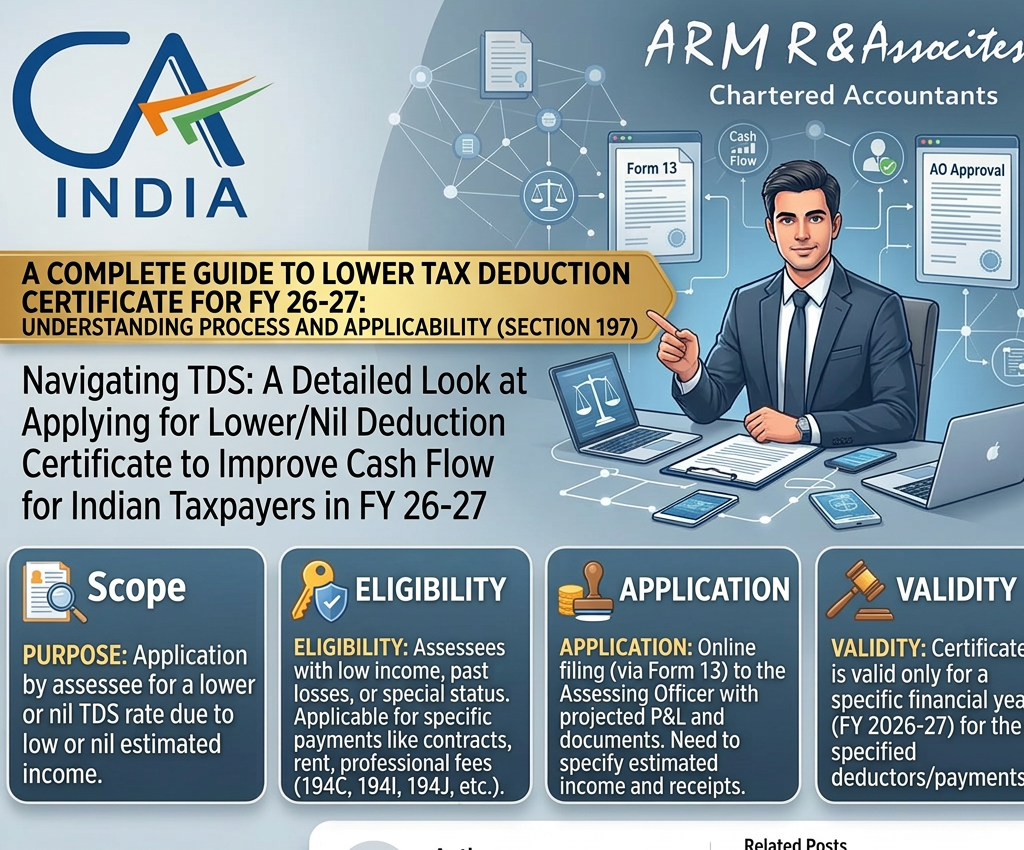
A Professional Advisory
By A R M R & Associates, Chartered Accountants
Introduction
Tax Deducted at Source (TDS) is a cornerstone of India’s income‑tax compliance framework. While it ensures timely tax collection, it often results in excess tax deduction where the prescribed TDS rates are higher than the taxpayer’s actual tax liability. This leads to blocked funds, working capital strain, and delayed refunds.
To mitigate this issue, the Income‑tax Act, 1961 provides for a Lower Tax Deduction Certificate (LDC) under Section 197. From Financial Year 2026–27, the Income‑tax Department has introduced a fully digital and faceless mechanism for issuing such certificates, making the process more transparent, efficient, and taxpayer‑friendly.
This article, prepared by A R M R & Associates, explains the concept, applicability, and benefits of obtaining a Lower Tax Deduction Certificate for FY 2026–27.
What is a Lower Tax Deduction Certificate?
A Lower Tax Deduction Certificate is an authorization issued by the Income‑tax Department permitting the deductor to deduct tax at a lower rate or Nil rate, instead of the standard TDS rate specified under the Act.
The certificate is issued after assessing the applicant’s estimated income and projected tax liability for the relevant financial year. Its objective is to ensure that tax deduction closely matches the actual tax payable, thereby preventing unnecessary cash outflows and refund claims.
Legal Framework
The issuance of a Lower Tax Deduction Certificate is governed by:
- Section 197 of the Income‑tax Act, 1961 – Empowers the tax authorities to issue certificates for lower or Nil TDS
- Rule 28 of the Income‑tax Rules, 1962 – Prescribes the manner and conditions of application
- Form No. 13 – Prescribed application form for seeking the certificate
From 1 April 2026, the application process is entirely digital and faceless, significantly reducing manual intervention and processing delays.
Who Should Consider Applying?
Based on our professional experience, the following taxpayers benefit the most from an LDC:
- Professionals such as Chartered Accountants, lawyers, consultants, and freelancers
- Contractors and sub‑contractors operating on low profit margins
- Businesses with carried‑forward losses or high depreciation
- Exporters and manufacturers with thin margins
- Individuals and senior citizens whose effective tax liability is lower than applicable TDS
For such taxpayers, excess TDS often leads to avoidable liquidity constraints during the year.
Types of Income Covered
Lower or Nil TDS certificates may be sought for various categories of income, including:
- Professional or technical fees (Section 194J)
- Contract payments (Section 194C)
- Rent (Section 194I)
- Interest income (Section 194A / 193)
- Commission or brokerage (Section 194H)
- Certain payments to non‑residents (Section 195)
Each case must be evaluated based on projected income and tax liability.
Application Process for FY 2026–27 (Digital Regime)
The procedure for obtaining a Lower Tax Deduction Certificate from FY 2026–27 is as follows:
- Online Filing of Form 13
Application is submitted electronically through the Income‑tax portal using PAN‑based login. - Electronic Verification
Verification through Digital Signature Certificate (DSC) or Electronic Verification Code (EVC). - Submission of Financial Information
Estimated income, previous years’ returns, tax payments, projected receipts, and supporting documents. - Faceless Examination
The application is reviewed electronically without any physical interaction. - Issuance of Certificate
Upon approval, the certificate specifies the applicable TDS rate and validity period.
Validity and Compliance
- The certificate is generally valid for the financial year in which it is issued, unless cancelled earlier.
- It must be shared with all concerned deductors, who are legally required to apply the approved TDS rate.
- Any material change in income or tax position should be appropriately disclosed.
Key Benefits of an LDC
- Improved cash flow and liquidity
- Reduced dependency on income‑tax refunds
- Better financial and tax planning
- Lawful reduction of excess tax deduction
Our Professional Advisory
At A R M R & Associates, we provide end‑to‑end assistance for:
- Evaluating eligibility for Lower / Nil TDS certificates
- Accurate income estimation and documentation
- Preparation and filing of Form 13
- Liaison and compliance support with deductors
Early application at the beginning of the financial year significantly improves processing timelines and financial outcomes.
Conclusion
With the introduction of a digital and faceless processing system from FY 2026–27, the Lower Tax Deduction Certificate has become an effective and practical tool for managing tax outflows and cash flows. Eligible taxpayers should proactively evaluate their position and apply early to avoid unnecessary TDS deductions during the year.
About A R M R & Associates
A R M R & Associates
Chartered Accountants
Website: https://www.armrca.com
Practice Areas: Income Tax | GST | Audit | Compliance | Advisory
