


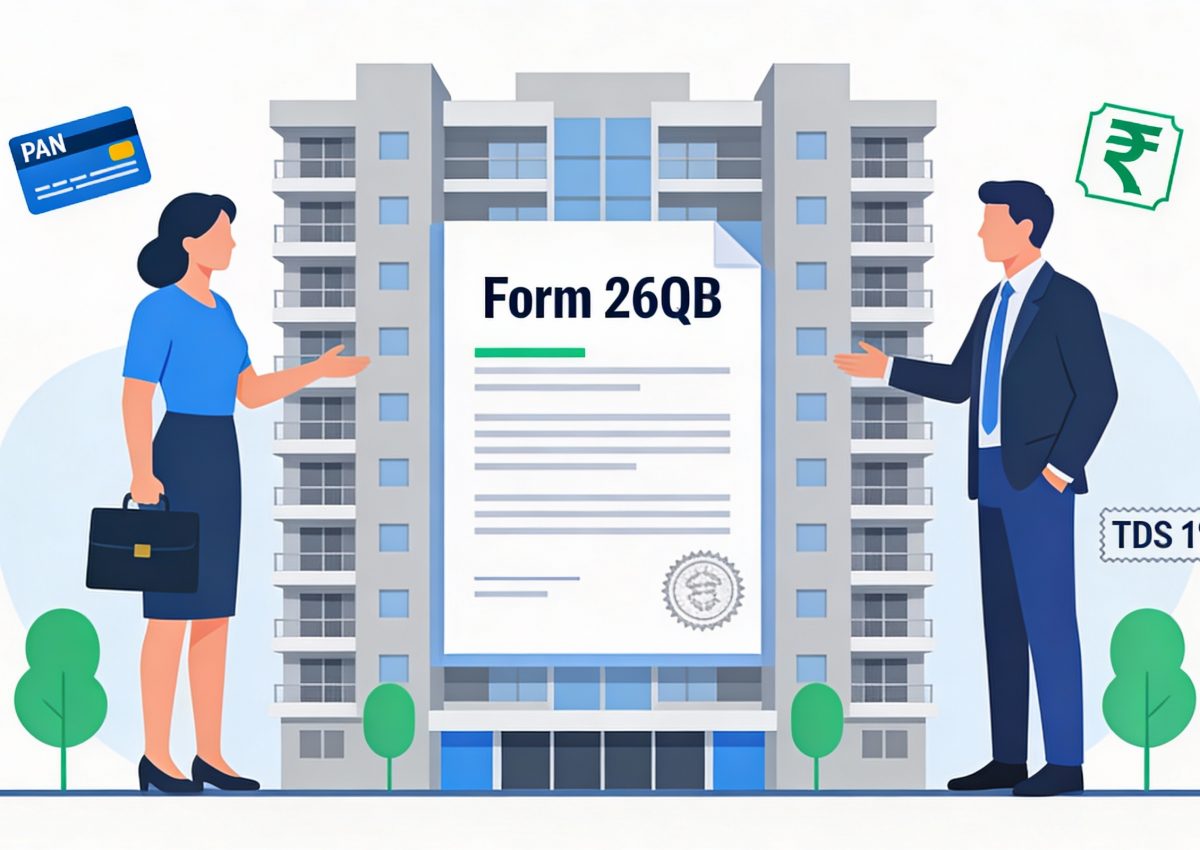
Buying or selling property has become more data‑driven than ever. In 2025, the Income‑tax Department is matching property details, PAN status and TDS in real time—so even small mistakes in Form 26QB or PAN can generate demands and notices.
This guide covers, in practical language:
- When 1% TDS under section 194‑IA applies
- How to correctly file Form 26QB
- What happens if PAN is inoperative (not linked with Aadhaar)
- How NRI seller deals are different (section 195)
- Latest CBDT relief for inoperative PAN short‑deduction demands
1. Basic rule – when is TDS on property applicable?
TDS on purchase of immovable property applies when:
- Buyer is any person (individual, HUF, company, etc.),
- Seller is a resident,
- Property is any land/building (residential or commercial) other than agricultural land, and
- Sale consideration is ₹50 lakh or more.
In such cases:
- Buyer must deduct 1% of the total consideration as TDS at the time of payment/credit.
- TDS is on whole consideration, not just the amount above ₹50 lakh.
- No TAN is needed; PAN of buyer and seller is mandatory.
If the seller is non‑resident, section 195 applies instead—discussed in section 4.
2. Form 26QB – how to file it correctly
Form 26QB is a combined challan‑cum‑statement for TDS on purchase of property. It is filed online and used to pay the 1% TDS.
2.1 Due date
- TDS deducted in a month must be paid and Form 26QB filed within 30 days from the end of that month.
Example: If you pay the seller and deduct TDS on 10 June 2025, Form 26QB must be filed by 30 July 2025.
2.2 Key details you must capture
While filling Form 26QB on the e‑filing / TIN portal, you need to enter:
- Buyer and seller details: Name, PAN, address, mobile, email
- Property address, PIN code, city and state
- Total consideration, amount paid till date and date of payment
- TDS amount (normally 1% of consideration)
- Whether property has more than one buyer or seller (in which case a separate 26QB per buyer–seller combination is required)
After successful payment:
- Download the acknowledgement of Form 26QB.
- Log in as buyer to download Form 16B (TDS certificate) and give it to seller
3. Inoperative PAN and short‑deduction demands
From 1 July 2023, PANs not linked with Aadhaar became “inoperative”. When buyers filed 26QB using such PANs, CPC often processed TDS at 20% u/s 206AA instead of 1%, raising short‑deduction demands.
3.1 What happens if seller’s PAN is inoperative?
If PAN is inoperative on the date of transaction/filing:
- Legally, section 206AA requires TDS at 20% where PAN is not furnished or invalid.
- Many buyers still deducted 1%, leading CPC to compute a 19% short‑deduction demand plus interest in 200A intimations.
This created hardship where sellers later regularised PAN by linking Aadhaar.
3.2 CBDT relief – Circular 6/2024 and Circular 9/2025
To address this, CBDT issued Circular 6/2024 and then expanded relief through Circular 9/2025. Broadly:
- For transactions up to 31 March 2024, if the deductee’s inoperative PAN became operative on or before 31 May 2024, then:
- No demand shall be raised for short deduction/collection (i.e., differential 19%).
- Deductor will not be treated as assessee‑in‑default.
- Circular 9/2025 extends relief for later periods:
- For transactions 1 April 2024 to 31 July 2025, no short‑deduction demand if PAN becomes operative on or before 30 September 2025.
- For transactions on or after 1 August 2025, no demand if PAN becomes operative within 2 months from end of the month of transaction.
In both cases, interest and penalty are also waived; the system demand is to be regularised.
3.3 Practical steps if you have a 26QB demand
If you receive a short‑deduction demand because seller’s PAN was inoperative:
- Check transaction date and date on which seller’s PAN became operative (via PAN status screen).
- If it fits within the above CBDT relief windows:
- File an online rectification request against the 200A intimation on the e‑filing portal, citing relevant CBDT circular number.
- Attach PAN status, 26QB acknowledgement and circular extract.
- If it falls outside relief period, you may have to:
- Pay differential TDS + interest, or
- Contest through regular appeal process if you have strong evidence that PAN was actually operative on that date.
For current deals, always confirm PAN is operative before registration / payment to avoid these issues.
4. Special case – NRI sellers (Section 195, not 26QB)
When the seller is an NRI, section 195 applies instead of 194‑IA. Form 26QB is not used; instead, the buyer:
- Must obtain a TAN,
- Deduct TDS on capital gains, not flat 1% on sale value,
- Deposit TDS using challan ITNS 281, and
- File Form 27Q (quarterly TDS return) and issue Form 16A.
4.1 TDS rates for NRI property sale in 2025
Broadly, for FY 2025‑26:
- Short‑term capital gain (holding < 24 months):
- TDS at slab rates (up to 30%) + surcharge + 4% cess.
- Long‑term capital gain (holding ≥ 24 months):
- TDS on LTCG typically at 12.5% or 20% base, depending on latest amendments, plus surcharge & cess; effective rate can go above 20%.
- If NRI obtains a lower‑deduction certificate (Form 13), TDS is at the rate and amount specified.
Because of high TDS, buyers often insist that the NRI seller obtains a lower TDS certificate based on actual capital‑gain working.
5. Common mistakes buyers make—and how to avoid them
From a CA’s perspective, most property TDS problems in 2025 arise from a few recurring mistakes.
5.1 Not checking residential status and using wrong section
- Deducting 1% with Form 26QB even though seller is NRI (should be section 195) leads to major future exposure.
- Always obtain a residential status declaration from seller and verify basic facts (days in India, overseas employment etc.).
5.2 Filing one 26QB instead of multiple forms
Where there are multiple buyers and/or sellers, the law requires one Form 26QB per buyer–seller combination.
Example: 2 buyers and 2 sellers → 4 separate 26QBs.
5.3 Ignoring inoperative PAN warnings
Portals now warn when PAN is inoperative, but buyers sometimes proceed to avoid deal delay. This can create avoidable demands later.
Best practice:
- Ask seller to link PAN–Aadhaar and show operative status before sale deed.
- If not possible, factor the higher TDS into negotiation; buyer can deduct higher rate and seller claims refund.
5.4 Missing the 30‑day filing deadline
Late filing of 26QB can attract:
- Interest u/s 201(1A) for late deduction/payment, and
- Late fee u/s 234E (₹200 per day, up to TDS amount).
Calendar‑based reminders or CA‑managed compliance can avoid this.
6. How a CA can add value in property deals
For most families, real estate is their largest investment. A CA can:
- Pre‑check section (194‑IA vs 195), rate, and PAN status before registration.
- Draft payment schedule that aligns TDS deduction with bank loan disbursement.
- Handle 26QB / TAN / 27Q filing, lower‑deduction applications, and rectifications.
- Help seller plan capital‑gains exemptions (sections 54, 54EC, 54F) to legally reduce tax.
the “first call before signing the sale deed” not only protects clients from expensive mistakes but also builds long‑term advisory relationships.
