

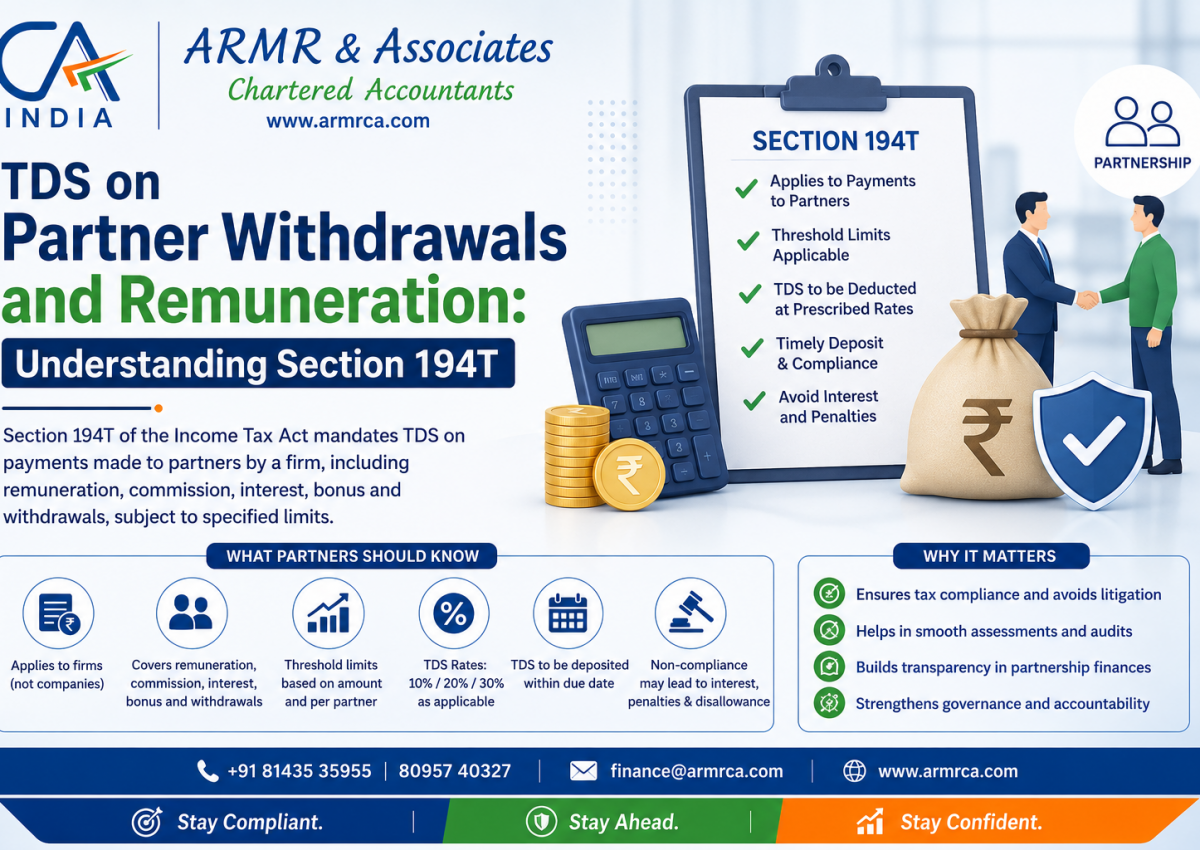
From FY 2025‑26 onwards, partnership firms and LLPs need to relook at how they pay partners. A new TDS provision, Section 194T, now covers certain payments made to partners. Naturally, one of the most common questions is:
“If partners withdraw money from the firm, is TDS required?”
This article explains, in a simple way, when TDS is compulsory, when it is not, and what happens if a firm ignores Section 194T.
1. What changed? Introduction of Section 194T
Until now, firms generally:
- Paid remuneration, interest on capital, commission, bonus to partners,
- Claimed deduction under Section 40(b), and
- Did not deduct TDS on these payments.
From 1 April 2025 (applicable for FY 2025‑26 onwards), Section 194T changes this by introducing a TDS obligation on specified payments from firms/LLPs to partners.
2. At a glance: What attracts TDS under Section 194T?
2.1 Covered payments and key conditions
TDS under Section 194T applies when all these are satisfied:
| Parameter | Condition for TDS under Section 194T |
| Payer | Partnership firm or LLP |
| Payee | Partner of that firm/LLP |
| Nature of payment | Salary/remuneration, bonus, commission, any other remuneration, interest to partners (deductible u/s 40(b)) |
| Threshold | Aggregate of such payments to a partner > ₹20,000 in a financial year |
| TDS rate | 10% |
| Time of deduction | Earlier of credit to partner’s account or actual payment |
Once the ₹20,000 threshold is crossed for a partner, TDS applies on the entire covered amount, not just on the excess.
3. TDS vs partner withdrawals: What is covered, what is not
A lot of confusion arises because firms loosely use the word “withdrawals” or “drawings”. The key distinction is between income‑type payments (where TDS applies) and capital‑type payments (where it does not).
3.1 Summary table – TDS applicability
| Type of payment to partner | Typical ledger treatment | TDS u/s 194T? | Why |
| Fixed/variable remuneration (salary) | Expense in P&L, allowed u/s 40(b) | Yes, if > ₹20,000 p.a. | Covered explicitly (remuneration) |
| Commission / bonus | Expense in P&L, u/s 40(b) | Yes, if > ₹20,000 p.a. | Covered explicitly |
| Interest on capital / loans | Interest expense in P&L, u/s 40(b) | Yes, if > ₹20,000 p.a. | Covered explicitly |
| Pure capital withdrawal / drawings | Reduction of capital/current account; not P&L expense | No | Not a 40(b) expense; return of capital |
| Share of profit | Appropriation of profit; exempt u/s 10(2A) | No | Not deductible expense; outside 194T |
4. Drawings vs remuneration: Practical illustrations
Example 1 – Monthly “drawings” which are actually salary
- Deed provides monthly remuneration of ₹7,00,000 per partner.
- Firm books this as “Partner’s remuneration” in P&L and claims deduction u/s 40(b).
- Partner’s capital/current account is credited monthly and he withdraws amounts during the year.
Analysis:
- Nature: Remuneration (not mere capital withdrawal).
- Annual covered amount: ₹7,00,000.
- Threshold of ₹20,000 clearly exceeded.
- TDS u/s 194T @ 10% = ₹70,000 for that partner.[cleartax]
Even if the firm labels the entries as “Drawings” in the ledger, the substance is salary/remuneration, so TDS is required.
Example 2 – Interest credited to capital account
- Interest on capital credited to Partner A during FY 2025‑26: ₹2,00,000.
- No other 194T‑covered payment to A.
Analysis:
- Nature: Interest to partner (deductible u/s 40(b)).
- Threshold: ₹2,00,000 > ₹20,000.
- TDS u/s 194T @ 10% = ₹20,000, deducted when interest is credited.
If the partner subsequently withdraws this interest from his capital account, that withdrawal itself does not trigger fresh TDS – the TDS obligation arose at the time of credit.
Example 3 – Pure capital withdrawal
- Partner B has capital balance of ₹30,00,000.
- He decides to withdraw ₹10,00,000 as reduction of capital.
- No remuneration or interest is credited for him during the year.
Analysis:
- Nature: Return of capital / drawings, not an expense.
- No P&L debit, no 40(b) deduction.
- No TDS u/s 194T, regardless of withdrawal amount.
5. Is TDS mandatory even if partner’s income is below taxable limit?
Yes. TDS under Section 194T depends on:
- Nature of payment (remuneration/interest etc.), and
- Aggregate amount (>₹20,000 per partner per year),
not on whether the partner’s eventual total income exceeds or falls below the basic exemption limit.
So, even if a partner’s total income (after deductions) is below ₹2.5 lakh (or applicable basic exemption):
- The firm must still deduct TDS on covered payments under Section 194T, once conditions are met.
- The partner can claim full TDS credit in their ITR. If their final tax liability is lower, they can obtain a refund from the Income‑tax Department.
6. What if the firm does not deduct TDS?
Non‑deduction or non‑payment of TDS under Section 194T has serious consequences for the firm.
6.1 Disallowance of 30% of expense – Section 40(a)(ia)
If TDS is:
- Not deducted at all; or
- Deducted but not deposited within prescribed time,
then 30% of the expense becomes disallowable under Section 40(a)(ia).
Illustration:
- Partner remuneration: ₹7,00,000
- TDS required but not deducted
- Disallowance: 30% of ₹7,00,000 = ₹2,10,000 added back to firm’s taxable income.
If the firm later deducts and pays the TDS, this disallowed portion can be allowed in a subsequent year, but the firm still suffers:
- Higher tax outgo now, and
- Interest on that additional tax.
6.2 Interest under Section 201(1A)
- If TDS is not deducted:
- Interest @ 1% per month (or part) from date deductible to date actually deducted.
- If TDS is deducted but not deposited:
- Interest @ 1.5% per month (or part) from date of deduction to date of payment.
This is over and above the TDS amount and disallowance.
6.3 Penalty and prosecution (in serious cases)
For serious or wilful defaults, the Department may initiate:
- Penalty up to the amount of TDS not deducted / paid.
- Prosecution under Section 276B for failure to remit TDS to Government.
While this is not common for small, inadvertent errors that are promptly corrected, it remains a legal risk.
7. Compliance checklist for firms and LLPs
From FY 2025‑26 onwards, every firm/LLP should do the following:
7.1 Review your partnership deed
- Identify all clauses relating to:
- Remuneration / salary,
- Interest on capital,
- Commission, bonus, etc.
- Ensure they are clearly defined (amount or formula) and consistent with Section 40(b).
7.2 Classify payments correctly
Separate partner‑related flows into:
| Category | TDS u/s 194T? |
| Profit share | No |
| Pure capital withdrawal | No |
| Remuneration / salary | Yes (if > ₹20,000 p.a.) |
| Interest on capital / loans | Yes (if > ₹20,000 p.a.) |
| Commission / bonus / other 40(b) remuneration | Yes (if > ₹20,000 p.a.) |
7.3 Build TDS tracking into your accounting
- Maintain partner‑wise ledgers that clearly distinguish:
- Profit share,
- Drawings,
- Remuneration,
- Interest.
- Once total covered payments to a partner exceed ₹20,000 in the year, start TDS at 10% on all such payments.
7.4 Educate partners
- Explain that TDS deducted is not an extra tax, but advance tax credit.
- Encourage partners to file their ITRs on time and claim refund where applicable.
8. Key takeaways
- Section 194T brings partner remuneration and interest squarely into the TDS regime from 1 April 2025.
- No TDS is required on pure capital withdrawals and share of profit, but TDS @ 10% applies to remuneration, interest, commission, bonus above ₹20,000 per partner per year.
- Mis‑classifying remuneration as “drawings” does not protect from TDS; what matters is the true nature of the payment.
- Non‑deduction can result in 30% disallowance, interest, and even penalty/prosecution.
Handled properly, Section 194T becomes just another compliance step, not a burden: firms stay safe, and partners get credit or refund through their returns.
