

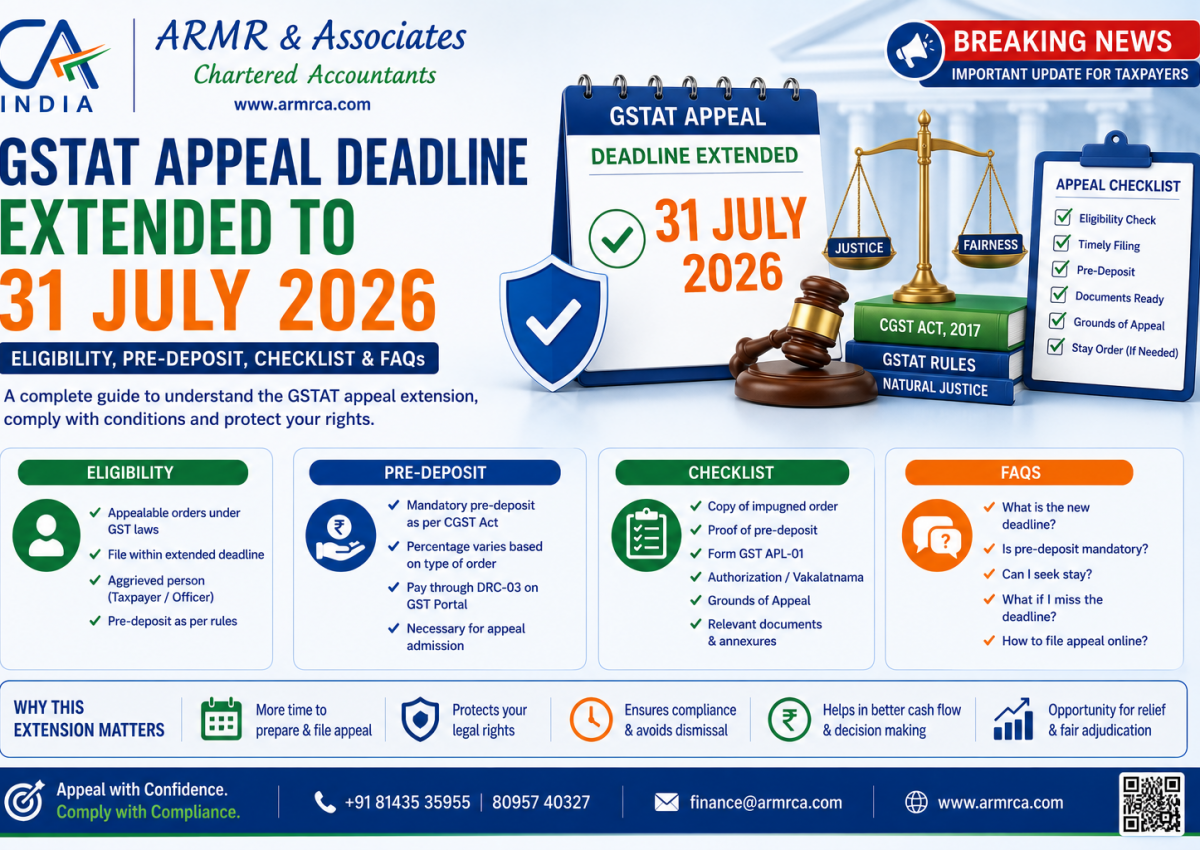
GSTAT appeal deadline extended to 31 July 2026: what businesses must know
The Government has extended the last date for filing appeals before the Goods and Services Tax Appellate Tribunal (GSTAT) to 31 July 2026, granting one more month for eligible taxpayers and the department to bring disputes before the Tribunal. However, the statutory framework under Section 112 of the CGST Act—including limitation, pre-deposit and documentation—remains fully applicable and continues to be strictly enforced.
As a GST-focused Chartered Accountant firm in Bangalore, ARMR & Associates regularly advises clients on GST appeals and litigation strategy. This article is designed to help you quickly assess whether your case can be taken to GSTAT within the extended window, and how to comply with the pre-deposit and filing requirements.
1. Scope of the 31 July 2026 extension
The extension is notified under Section 112 and applies to specific categories of orders, effectively shifting the outer limit for such cases to 31 July 2026.
For ease of understanding:
- Taxpayer appeals (Section 112(1))
- Orders communicated before 1 May 2026 may be appealed to GSTAT up to 31 July 2026.
- Orders communicated on or after 1 May 2026 follow the normal limitation of three months from the date of communication.
- Departmental applications (Section 112(3))
- Orders passed before 1 February 2026 may be taken up by the department until 31 July 2026.
- Orders passed on or after 1 February 2026 continue with the standard six‑month period under Section 112(3).
For businesses that have already gone through the first appeal stage, this is a valuable opportunity to reassess pending disputes and decide whether to escalate to GSTAT.
2. Who is eligible to file a GSTAT appeal?
Under Section 112, GSTAT serves as the second appellate forum in GST.
Eligible categories include:
- Taxpayers / registered persons aggrieved by orders passed by the First Appellate Authority (Section 107) or Revisional Authority (Section 108).
- Unregistered persons where the order under GST law directly affects them (for example, detention or confiscation cases).
- Department / revenue, acting through an authorised officer on directions of the Commissioner, under Section 112(3).
- Cross-objectors, where a notice of appeal has been served and a memorandum of cross‑objections is filed within the prescribed time.
Section 112(2) also empowers GSTAT to refuse to admit small-value appeals where the amount involved does not exceed the notified threshold. This threshold should be checked against the latest Tribunal rules before filing a low-value case.
3. Limitation and condonation: extended date vs normal timelines
Even with the extension, the limitation structure in Section 112 continues to govern appeal timelines.
- Taxpayer appeals (Section 112(1))
- Normally, an appeal must be filed within three months from the date of communication of the order.
- GSTAT may condone delay for a further three months if sufficient cause is shown.
- Departmental appeals (Section 112(3))
- Normally, an application must be filed within six months from the date of the order, with a further six‑month condonation window in appropriate cases.
- Effect of the extended date
- For orders covered by the notification (e.g. communicated before 1 May 2026 or passed before 1 February 2026), the outer limit is shifted to 31 July 2026.
- Condonation is then computed with reference to this notified outer date, but GSTAT cannot condone beyond the statutory maximum.
In practice, this means you should aim to file well before 31 July 2026, rather than relying on condonation as a default strategy.
4. Pre-deposit under Section 112: additional 10% at Tribunal stage
Recent amendments and clarifications have refined the pre-deposit requirement at the Tribunal stage:
- Admitted portion
- The appellant must pay, in full, such part of tax, interest, fine, fee and penalty as is admitted.
- Additional GSTAT pre-deposit (Section 112(8))
- An amount equal to 10% of the remaining tax in dispute, in addition to the amount paid at first appeal stage under Section 107(6).
- Subject to a cap of Rs. 20 crore (per CGST/SGST component, as notified).
- Penalty-only orders
- Where only penalty is in dispute, the proviso requires a pre‑deposit of 10% of the penalty, again over and above the amount payable under Section 107.
- Deemed stay of recovery (Section 112(9))
- Once the required pre-deposit is paid and the appeal is filed, recovery of the remaining amount is deemed to be stayed until disposal of the appeal.
This structure is particularly important for businesses facing large demands, where pre-deposit planning can materially impact cash flows.
5. Illustrative pre-deposit computation (with chart-ready data)
Consider the following example:
- Total disputed tax: ₹10,00,000
- Amount admitted by appellant: ₹1,00,000
- Remaining disputed tax: ₹9,00,000
Assume the taxpayer has already deposited 10% of the disputed tax (₹90,000) at the first appeal stage under Section 107(6).
At the GSTAT stage:
- Admitted liability: ₹1,00,000 – payable in full.
- Additional GSTAT pre-deposit: 10% of remaining disputed tax (₹9,00,000) = ₹90,000, over and above the Section 107(6) deposit.
- Balance disputed amount: ₹8,10,000 – remains in dispute with recovery stayed under Section 112(9).
This can be visualised for readers as a simple three‑slice pie chart:
- Admitted liability – 10%
- Additional GSTAT pre-deposit – 9%
- Balance disputed amount – 81%
6. Pie chart dataset (for WordPress)
You can use this dataset in any WordPress chart plugin (or embed as a table and convert):
text
Component,Amount (INR),Share (%),Explanation
Admitted liability,100000,10,”Amount admitted by appellant and payable in full”
Additional GSTAT pre-deposit,90000,9,”10% of disputed tax of 900000 in this illustration”
Balance disputed amount,810000,81,”Amount continuing in dispute before Tribunal”
This dataset is aligned with the current Section 112(8) framework and is suitable for infographics or explainer visuals.
7. Documentation checklist before filing with GSTAT
From a practical standpoint, successful GSTAT appeals depend heavily on documentation discipline. Drawing on the Tribunal rules and current practice:
- Orders and notices
- Order-in-Original and Order-in-Appeal / Revisional Order
- Show cause notice and relied-upon documents
- Submissions and pleadings
- Statement of facts and issue‑wise grounds of appeal
- Copies of replies filed before adjudicating and appellate authorities
- Pre-deposit and fee evidence
- Computation of admitted vs disputed amounts
- Proof of pre-deposit under Section 107(6) and Section 112(8)
- Proof of appeal fee payment as per Tribunal rules[caclubindia]
- Authority and support
- Board resolution/authorisation or vakalatnama
- Paper book index, case law compilation, circulars and notifications relied upon
At ARMR & Associates, we encourage clients to maintain a single, structured “GSTAT appeal file” (digital or physical) with an index for quick reference during Registry scrutiny and hearing.
8. Practical issues and GSTAT portal tips
Based on recent guidance and advisories:
- Check auto-populated pre-deposit
- The GSTAT portal may auto‑fill pre-deposit details using GSTN data; discrepancies should be corrected with a clear working and supporting documents, including any High Court orders altering pre-deposit.
- Use of Electronic Cash Ledger
- Pre-deposit is generally expected to be paid through the Electronic Cash Ledger, not by utilising ITC, and mis‑use of ITC for pre-deposit can trigger scrutiny objections.
- Final acknowledgement is critical
- The appeal is considered filed only when the final acknowledgement/appeal number is generated by the GSTAT portal. Screenshots of intermediate steps are not a substitute.
- Condonation must be well-argued
- Any delay should be backed by a properly drafted condonation petition with evidence (e.g. illness, system issues, pending clarification), recognising that condonation beyond statutory limits is not permissible.
9. FAQs on GSTAT deadline and pre-deposit
Q1. What is the revised last date for filing GSTAT appeals?
The Government has extended the last date for filing eligible appeals and applications before GSTAT to 31 July 2026, for orders covered by the notification.
Q2. Does this extension cover all GST orders?
No. Orders beyond the specified cut‑off dates still follow the normal three‑month (taxpayer) and six‑month (department) timelines under Section 112.
Q3. What is the mandatory pre-deposit for GSTAT appeals?
An appellant must pay the admitted amount in full and an additional 10% of the remaining disputed tax, over and above the first-appeal pre-deposit, subject to a cap of Rs. 20 crore.
Q4. How are penalty-only cases treated?
For penalty-only orders, the appellant must deposit 10% of the penalty amount in addition to the amount payable under Section 107.
Q5. Does pre-deposit automatically stay recovery?
Yes. Once the statutory pre-deposit is paid and the appeal is filed, recovery of the remaining amount is deemed stayed under Section 112(9) until the appeal is decided.
Q6. Can GSTAT condone delay beyond the extended date?
GSTAT can condone delay only within the statutory condonation window; it cannot condone delay beyond that outer limit, even where equities appear strong.
10. How ARMR & Associates can help with GSTAT appeals
For businesses in Bangalore and across India, a GSTAT appeal is both a legal and strategic decision. With the extended deadline up to 31 July 2026, this is the right time to revisit pending disputes and plan the next steps carefully.
ARMR & Associates, Chartered Accountants, offers end‑to‑end support on:
- Evaluating whether to escalate a GST dispute to GSTAT under Section 112.
- Computing and verifying pre-deposit, including complex/penalty-only cases.
- Drafting statements of facts, grounds of appeal and condonation applications.
- Preparing documentation, paper books and evidence bundles.
- Handling GSTAT portal filing and liaison, alongside broader GST advisory.
Contact Us : mahesh@armrca.com and +91 81435 35955.
